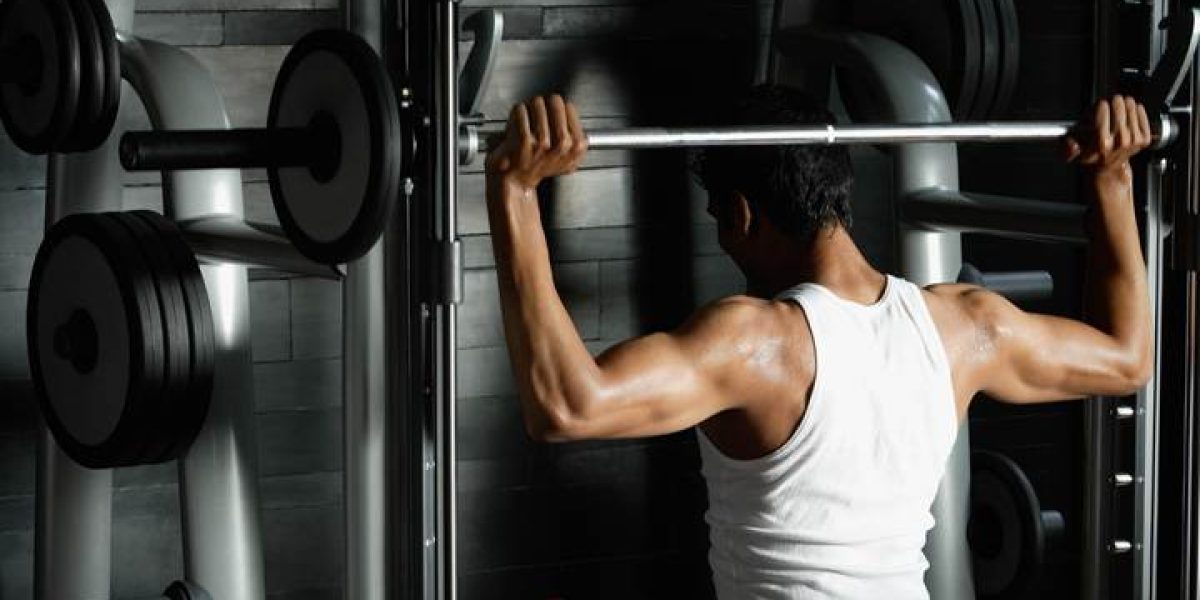
The overhead press is the most honest lift in the gym. Nothing supports you, nothing bounces, and nothing hides a weak brace. You stand with a barbell on your front deltoids and move it from clavicle height to full elbow lockout using only shoulder flexion, elbow extension, and a rigid torso. Master the overhead press and you build stronger deltoids, a more stable scapula, and a trunk that holds position under load.
Most lifters stall on this lift for mechanical reasons, not motivational ones. The bar drifts forward, the ribcage flares, the elbows spread, and the shoulder ends up working at a longer moment arm than it can handle. This guide breaks the movement down joint by joint, shows the exact positions on video-style diagrams, and gives you the programming to add weight to the bar without irritating the shoulder.
What the Overhead Press Actually Trains
The press is a compound movement, but the workload is not shared evenly. The anterior deltoid drives shoulder flexion. The medial deltoid takes over as the humerus climbs past shoulder height. The triceps brachii finishes the lockout. Underneath that, the serratus anterior and trapezius rotate the scapula upward so the humerus has room to travel.
| Structure | Role in the press | What it feels like when it works |
|---|---|---|
| Anterior deltoid | Prime mover in the first half of the lift | Burn at the front of the shoulder |
| Medial deltoid | Dominant above shoulder height | Fatigue on the side of the shoulder |
| Triceps brachii | Elbow extension and lockout | Sticking point clears at the top |
| Serratus anterior and lower trapezius | Scapular upward rotation | Room overhead with no pinching |
| Rotator cuff | Centers the humeral head in the socket | Smooth, quiet shoulder |
| Glutes, abs, spinal erectors | Anti extension bracing | Torso stays stacked, no arch |
Research using surface electromyography by Coratella and colleagues (2022) found that free barbell pressing produced higher muscle excitation than machine shoulder pressing, because the lifter must stabilize the trajectory instead of the machine doing it. That instability is the point.
The Biomechanics That Decide Every Rep
Three mechanical facts explain almost every press problem.
First, torque demand depends on horizontal distance. When the bar sits ahead of the mid-foot, the load creates a longer moment arm at the shoulder and spine. Two inches of forward drift can feel like ten pounds of added weight.
Second, the shoulder loses mechanical advantage as the arm elevates. Maximum shoulder flexion torque declines at higher elevation angles, which is why the mid range feels heaviest and why the lockout must be earned with a shrug rather than a grind.
Third, the shoulder blade must move. Scapulohumeral rhythm describes the coordinated action of the glenohumeral joint and the scapulothoracic joint during arm elevation. Roughly one third of overhead range comes from the scapula rotating upward. Block that rotation by keeping the shoulders pinned down and you crowd the subacromial space.
How to Perform the Overhead Press, Step by Step
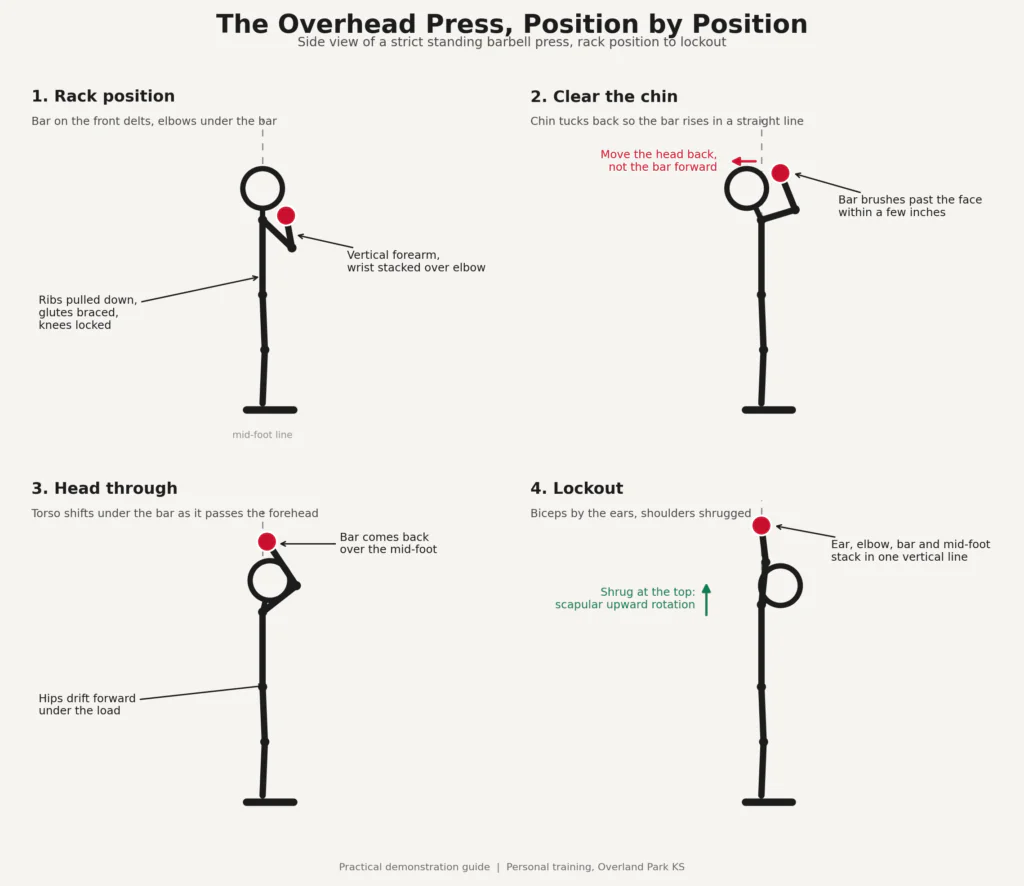
- Set the rack height. The pins sit at upper chest level. Unrack with the knees, not the back.
- Build the rack position. Bar on the front deltoids, touching or nearly touching the clavicle. Grip just outside the shoulders. Wrists stacked over the elbows.
- Brace. Squeeze the glutes, pull the ribs down toward the pelvis, and take a breath into the belly. Knees locked, feet hip width.
- Clear the chin. Push the head back into a slight chin tuck. The bar rises past the face in a straight line.
- Drive the head through. Once the bar passes the forehead, move the torso forward under it. The bar returns over the mid-foot.
- Finish with a shrug. Lock the elbows, then elevate the shoulders. Biceps end up beside the ears.
- Lower with control. Reverse the path. Absorb the bar on the front deltoids rather than the wrists.
Bar Path Is the Whole Game
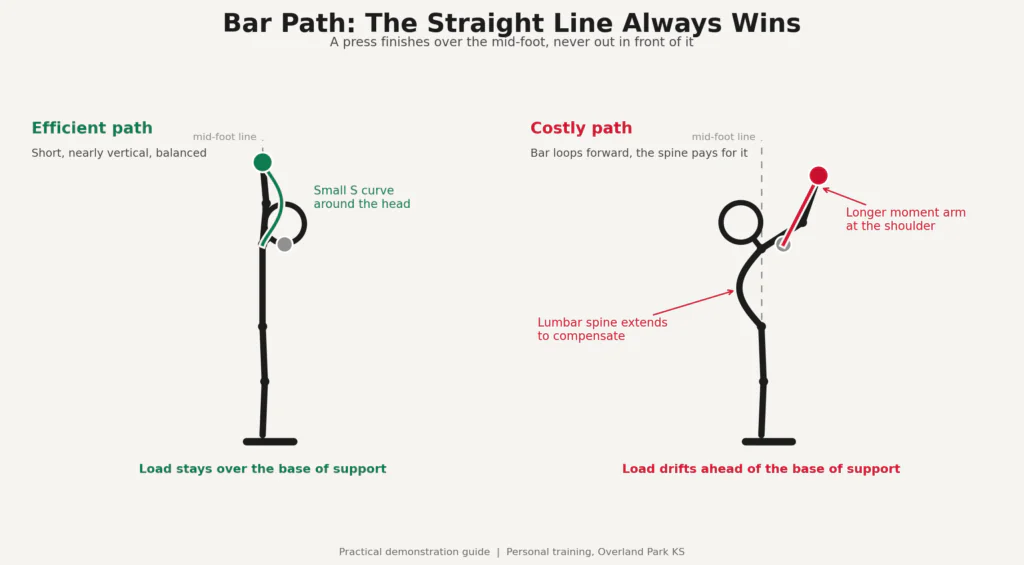
A correct press traces a shallow S curve. The bar moves slightly back around the face, then slightly forward as the head clears, finishing directly over the mid-foot. That keeps the system balanced over the base of support.
A forward path does two things at once. It lengthens the moment arm at the shoulder, and it forces the lumbar spine into extension to keep the center of mass over the feet. That leaning back is not core weakness in most cases. It is a balance strategy triggered by a bar that went the wrong way. Fix the path and the arch usually disappears.
Grip Width and Elbow Position
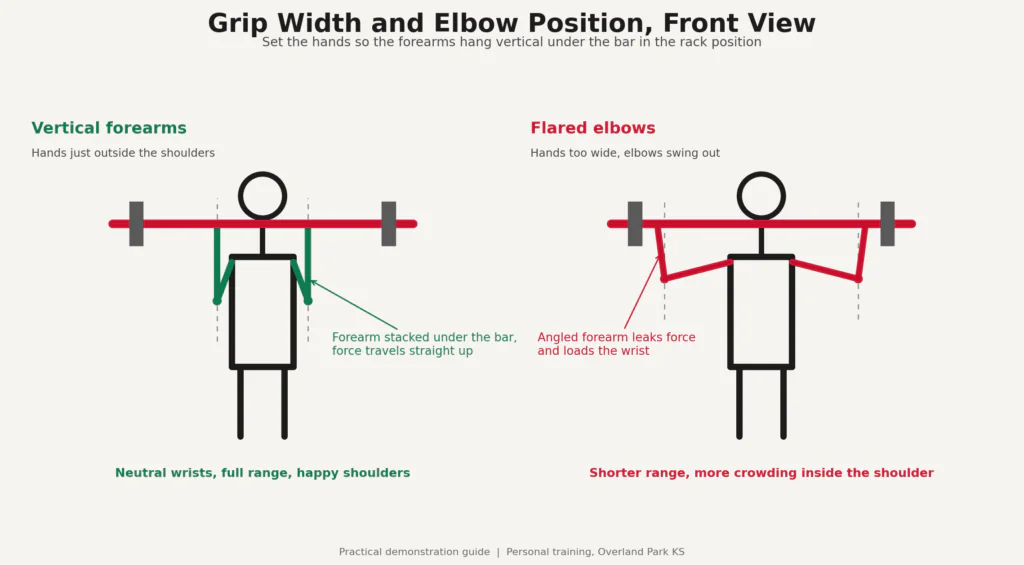
Set the grip so the forearms are vertical when viewed from the front in the rack position. A grip that is too wide angles the forearm, leaks force sideways, and loads the wrist. A grip that is too narrow lengthens the range and makes the rack position harder to hold. Knuckles point at the ceiling. The bar sits in the heel of the palm, not the fingers.
Common Faults and Their Fixes
| Fault | Mechanical cause | Correction |
|---|---|---|
| Bar drifts forward | Head does not move back | Chin tuck before the press, then drive the head through |
| Lower back arches hard | Balance compensation or weak brace | Squeeze glutes, ribs down, reduce load 10 percent |
| Elbows flare out | Grip too wide | Narrow the grip until forearms are vertical |
| Wrists bend back | Bar sitting in the fingers | Move the bar into the palm and stack the wrist |
| Shoulder pinch overhead | Limited scapular upward rotation | Add serratus and lower trapezius work, shrug at lockout |
| Knees soften each rep | Turning a strict press into a push press | Lock the knees, or program the push press on purpose |
Standing, Seated, Barbell, or Dumbbell
Saeterbakken and Fimland (2013) tested one repetition maximum and muscle activity across four shoulder press variations. The standing barbell press allowed the heaviest load, roughly seven percent more than the standing dumbbell press. The variations requiring the most stability produced the greatest deltoid activity.
| Variation | Load potential | Best used for |
|---|---|---|
| Standing barbell press | Highest | Absolute strength and full body bracing |
| Seated barbell press | High | Shoulder hypertrophy with less trunk fatigue |
| Standing dumbbell press | Moderate | Deltoid activation and side to side balance |
| Half kneeling or Z press | Lower | Removing the legs, exposing trunk and mobility limits |
| Landmine press | Lower | Shoulders with limited overhead range |
Programming the Press
The press adds weight slowly because the working muscles are small. Patience is a technique cue here.
- Beginner: 3 sets of 5 at RPE 7, twice per week. Add 2.5 pounds per week.
- Intermediate: 4 sets of 5 heavy on day one, 3 sets of 8 to 10 dumbbell pressing on day two.
- Hypertrophy focus: 3 to 4 sets of 8 to 12, one to two reps in reserve, with lateral raises and face pulls as accessories.
- Support work: overhead carries, dips, push press, and thoracic extension mobility.
Two pressing sessions per week is enough for nearly everyone. Track bar path quality, not just weight moved.
Frequently Asked Questions
Is the overhead press bad for your shoulders?
No. Pressing overhead with a straight bar path, adequate scapular upward rotation, and sensible loading is well tolerated by healthy shoulders. Pain usually comes from a forward bar path, a grip that is too wide, or pressing more volume than the tissue is prepared for.
Should I press behind the neck?
Only if you have full overhead range and a specific reason. Behind the neck pressing increases medial and posterior deltoid excitation, but it places the shoulder in maximum external rotation and abduction. Most lifters get better results from a front press with a shrug at lockout.
How much should I be able to overhead press?
A reasonable intermediate standard is around 0.6 times bodyweight for a single repetition for men and around 0.4 times bodyweight for women. Individual structure matters, so treat these as reference points rather than targets.
Why can I bench far more than I press?
The bench press uses the pectoralis major across a shorter range with a bench supporting the torso. The standing press removes that support and gives the deltoids a longer, less mechanically favorable path. A press near 60 percent of your bench is typical.
Can I press if I cannot get my arms fully overhead?
Work the range you own. Use a landmine press or an incline dumbbell press while you build thoracic extension, lat length, and serratus strength. Force overhead range and the lumbar spine will supply what the shoulder cannot.
Train the Press With a Coach Who Watches the Details
Bar path, grip width, and rib position are hard to self assess while a loaded barbell is over your head. Our personal training clients in Overland Park get their press filmed, corrected, and programmed against real strength standards. Certified through NASM and NCSF, with additional credentials in bodybuilding coaching through J3 University and in soft tissue work through Rock Tape, we coach the lift and the recovery around it.
Book a consultation and let us look at your press.