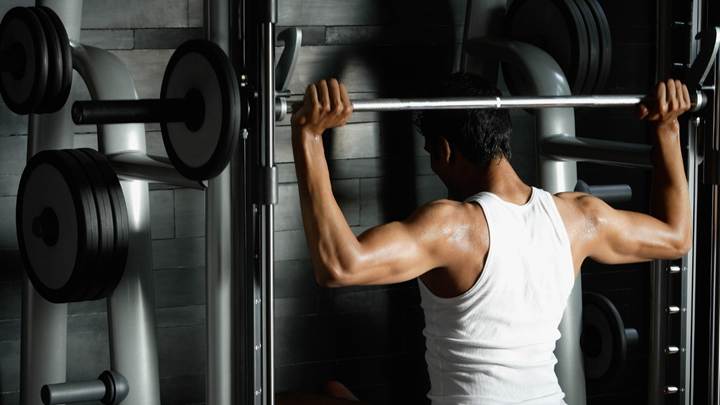

The barbell vs dumbbell question has a clear answer once you stop asking which tool is better and start asking which one is better at a specific job. A barbell connects both hands to one load on one path, so it allows the heaviest weight and the smallest progression steps. Dumbbells split the load in two, which adds range of motion, exposes side to side differences, and forces the stabilizers to work.
Neither tool builds a different muscle. The pectoralis major does not know what it is holding. What changes is the load you can handle, the path your joints are allowed to travel, and how much of the effort goes into controlling the weight instead of moving it. Understanding those three variables tells you exactly when to pick up each one.
Barbell vs Dumbbell Comparison
| Training goal | Better tool | Reason |
|---|---|---|
| Maximum strength | Barbell | Highest absolute load and stable path |
| Progressive overload | Barbell | Increments as small as 2.5 pounds total |
| Muscle growth | Either | Similar activation when effort and volume match |
| Fixing side to side imbalance | Dumbbell | Each limb moves its own load |
| Joint friendly pressing | Dumbbell | Wrist and shoulder rotate freely |
| Home gym on limited space | Dumbbell | No rack, no spotter, less floor |
| Sport and athletic carryover | Both | Bilateral power plus unilateral control |
Load Potential and Progressive Overload
The barbell wins on absolute load. Saeterbakken and colleagues (2011) reported that the one repetition maximum barbell bench press was around 17 percent greater than the dumbbell version. In shoulder pressing, Saeterbakken and Fimland (2013) found the standing barbell press allowed roughly 7 percent more weight than the standing dumbbell press.
The bigger advantage is quieter. Progression on a barbell can move in 2.5 pound total steps with microplates. Dumbbell racks usually jump 5 pounds per hand, which is 10 pounds of total load.
At a 135 pound press, the next barbell step is a 3.7 percent increase. The next dumbbell pair is often 8 percent or more. That is why lifters stall on dumbbells and blame their strength when the real problem is the size of the jump. The fix is to hold the same pair and add repetitions, sets, or controlled eccentric time until the next weight is earned.
Range of Motion and the Loaded Stretch
Dumbbells win on range. A barbell has a hard stop, since the bar cannot pass through the ribcage. Dumbbells travel past that line.
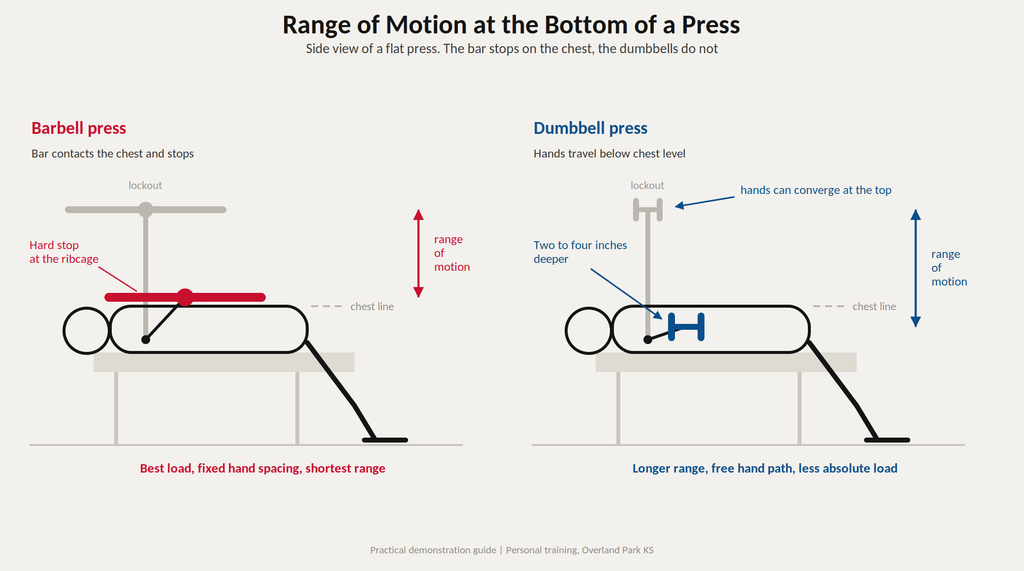
That extra two to four inches puts the pectoralis major under load at longer muscle lengths, and training at long muscle lengths is one of the more reliable findings in the hypertrophy literature. Dumbbells also let the hands converge at the top, which allows more shoulder horizontal adduction than a fixed bar permits.
The trade is control. Every inch of extra range is an inch the shoulder must stabilize on its own. Beginners and anyone with a cranky shoulder should earn that depth gradually rather than dropping into it.
What Each Tool Does With a Strength Imbalance
Most people are measurably stronger on one side. Heinecke and colleagues (2020) found dominant arm dumbbell repetitions were significantly higher than non dominant repetitions in trained athletes. Bilateral testing also tends to show a deficit, meaning the sum of both limbs working alone exceeds what they produce together.
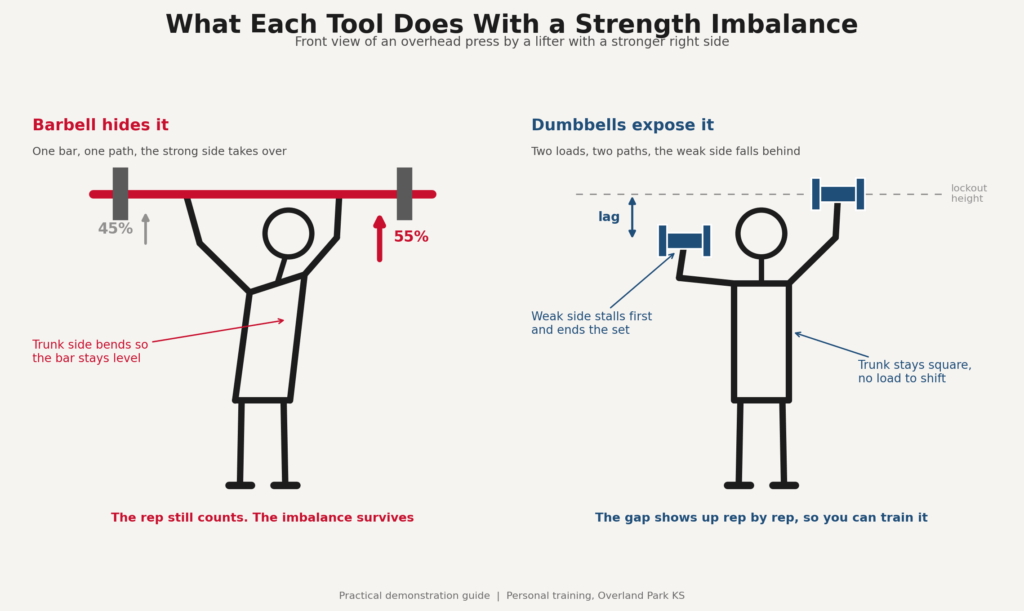
A barbell lets the strong side quietly contribute more. The bar stays level, the trunk side bends, and the rep still counts. Dumbbells remove that option. The weak side either finishes the repetition or the set ends. That feedback is the entire case for programming unilateral work, not some vague idea about functional training.
What the Research Actually Shows for Muscle Growth
| Study | Comparison | Finding |
|---|---|---|
| Welsch, Bird and Mayhew (2005) | Barbell vs dumbbell bench | Similar pectoralis major and anterior deltoid activation, longer activation time with the barbell |
| Farias and colleagues (2017) | Smith, barbell and dumbbell bench across four sets | Differences in repetitions and total volume between modes |
| Saeterbakken and Fimland (2013) | Barbell vs dumbbell shoulder press | Greater deltoid activation with dumbbells, greater biceps and triceps activation with the barbell |
| Coratella and colleagues (2022) | Barbell vs machine overhead press | Higher excitation with free weights that require trajectory control |
Read together, the message is consistent. Free weight pressing produces similar prime mover activation whether the load is in one bar or two hands. The differences show up in stabilizer demand, total load, and range. Effort and weekly volume still drive growth more than the implement.
Movement by Movement
| Exercise | Barbell version | Dumbbell version | Best default |
|---|---|---|---|
| Horizontal press | Bench press | Dumbbell bench press | Barbell for strength, dumbbell for volume |
| Vertical press | Strict overhead press | Dumbbell shoulder press | Barbell for load, dumbbell for shoulder comfort |
| Horizontal pull | Barbell row | Single arm row | Dumbbell, since the bar limits scapular travel |
| Hip hinge | Deadlift and Romanian deadlift | Dumbbell Romanian deadlift | Barbell by a wide margin |
| Squat pattern | Back squat and front squat | Goblet squat and split squat | Barbell for load, dumbbell for unilateral work |
| Elbow flexion | Barbell curl | Dumbbell curl | Dumbbell, thanks to free forearm rotation |
Two patterns stand out. Heavy hinging and squatting belong to the barbell, because the load required exceeds what most people can hold in their hands. Rowing and curling belong to the dumbbell, because the bar restricts the shoulder blade and locks the wrist into one position.
How to Program Both
Use the barbell first in the session, while the nervous system is fresh and technique is sharp. Use dumbbells afterward for volume, symmetry, and range.
- Day one: barbell bench press 4 sets of 5, then dumbbell incline press 3 sets of 10
- Day two: barbell overhead press 4 sets of 5, then single arm dumbbell row 3 sets of 10 per side
- Day three: barbell squat or deadlift 4 sets of 4, then dumbbell split squat 3 sets of 8 per leg
Track the barbell lifts by weight. Track the dumbbell lifts by repetitions at a fixed pair. That gives you two progression levers instead of one.
Frequently Asked Questions
Which builds more muscle, barbells or dumbbells?
Neither has a decisive edge when sets, effort, and proximity to failure are matched. Dumbbells offer more range at the bottom. Barbells allow more total load. Both produce similar activation in the prime movers, so program choice matters more than implement choice.
Can I get strong with dumbbells only?
Yes, up to a point. Dumbbells build real pressing and pulling strength, and most gyms stock pairs heavy enough to challenge the upper body for years. The limit appears in the squat and hinge, where the load a barbell can carry far exceeds what your hands can hold.
Are dumbbells safer than barbells?
They are easier to bail out of, since you can drop them to the sides without a spotter or safety pins. They are not automatically safer, because the extra range and the free path place more demand on the shoulder. Technique and load selection decide safety, not the shape of the handle.
Why can I lift so much less with dumbbells?
Three reasons stack up. Each limb works alone, so the bilateral deficit applies. Stabilizing two independent weights costs force. The longer range means more work per repetition. A dumbbell total that is 15 to 20 percent below your barbell number is normal.
Should beginners start with barbells or dumbbells?
Start with both. Dumbbells teach control and reveal imbalances early. Barbells teach bracing and give you a clean way to add weight every week. A beginner using only one of the two is leaving progress on the table.
Train With a Coach Who Picks the Right Tool for You
Choosing between a barbell and dumbbells is a programming decision, not a preference. Our personal training clients in Overland Park get their imbalances measured, their loads assigned, and their progressions planned across both tools. Our Overland Park fitness trainers certified through NASM and NCSF, with bodybuilding coaching credentials through J3 University and recovery work through Rock Tape, we build the program around your body rather than the equipment.
Book a consultation and let us build the right plan.