The hamstrings are three muscles that run along the back of the thigh: the biceps femoris (long and short head), semimembranosus, and semitendinosus. These muscles are responsible for two primary biomechanical functions: knee flexion and hip extension. They perform this work across nearly every movement the lower body executes. Weak hamstrings do not just limit leg strength. They disrupt the entire posterior chain, compromise knee joint stability, and significantly raise the risk of muscle strain injuries during high-speed activities like sprinting, cutting, and jumping. Knowing which hamstring workouts actually develop all three heads through both of their functional roles is what separates an effective leg training program from a generic one.
At Fitness Factory KC, our certified trainers build every lower-body program around the science of balanced posterior chain development. The top 10 hamstring workouts below are selected based on EMG activation research, biomechanical loading principles, and practical programming experience across athletes, general fitness clients, and women’s strength training.
Why Hamstring Training Requires a Dual Approach
The hamstrings are biarticular muscles, meaning they cross both the hip joint and the knee joint. This means they cannot be fully trained through a single movement pattern. Hip hinge exercises like Romanian deadlifts and good mornings load the hamstrings primarily through hip extension and train the muscle in its lengthened position. Knee flexion exercises like lying leg curls and Nordic curls load the hamstrings by bending the knee against resistance.
EMG research consistently shows that hip hinge movements preferentially activate the semitendinosus and semimembranosus, while knee flexion exercises produce stronger biceps femoris activation. A complete hamstring program trains both patterns within the same weekly structure to develop every muscle head and reduce the risk of imbalance-related injuries.
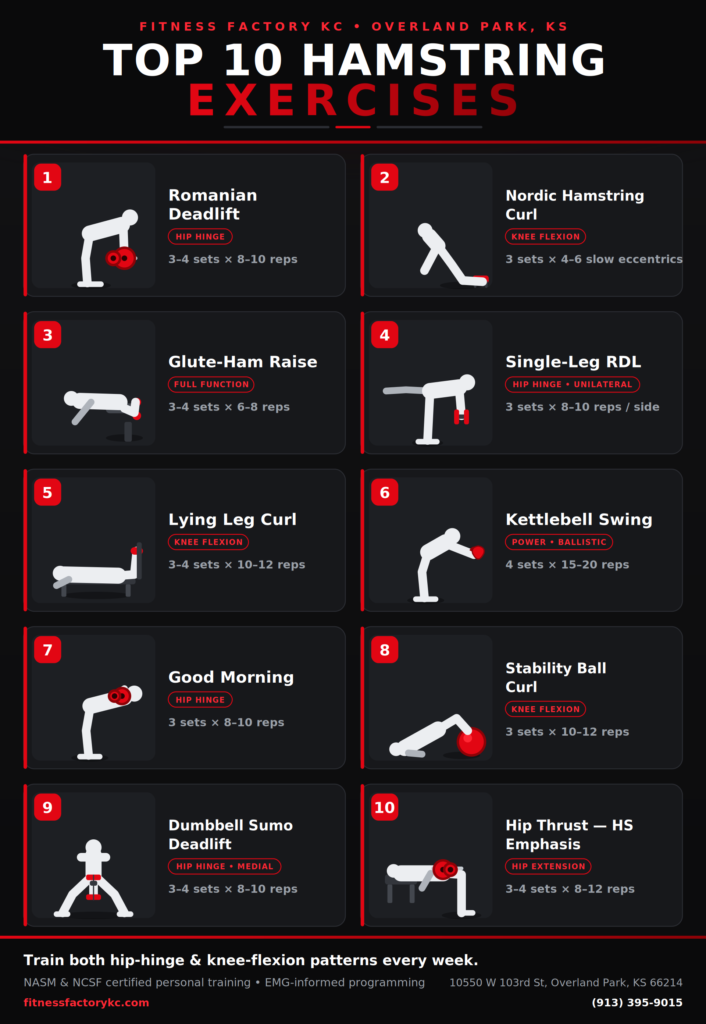
The Top 10 Hamstring Workouts
1. Romanian Deadlift (RDL)
The Romanian deadlift is the most effective compound exercise for hamstring development. It loads the hamstrings through a large range of hip flexion while the knee remains relatively fixed, creating substantial mechanical tension in the lengthened position, which is the primary driver of muscle hypertrophy. A 2025 PubMed-indexed intervention study found that six weeks of eccentrically biased RDL training increased biceps femoris long head fascicle length by 9%, directly reducing injury vulnerability at the muscle’s distal region where most strains occur.
How to Perform:
- Stand with feet hip-width apart, holding a barbell or dumbbells
- Hinge at the hips with a neutral spine, pushing the hips back
- Lower the weight along the legs until a deep stretch is felt in the hamstrings, typically just below the knee
- Drive the hips forward to return to standing, keeping the bar close to the body throughout
Sets/Reps: 3 to 4 sets of 8 to 10 reps
2. Nordic Hamstring Curl
The Nordic hamstring curl is among the most research-supported exercises for hamstring injury prevention. It trains the hamstrings eccentrically under full bodyweight resistance, generating very high levels of muscle tension in the lengthened range the exact position where most hamstring strains occur during sprinting’s late swing phase. Research published in Medicina (2026) confirmed that the Nordic exercise emphasizes semitendinosus activation, making it a critical complement to biceps femoris-dominant exercises. Meta-analyses of athlete populations have found that consistent Nordic curl programs reduce hamstring injury rates by over 50%.
How to Perform:
- Anchor the ankles under a fixed surface or have a partner hold them
- Start kneeling tall with hips fully extended
- Slowly lower the torso toward the floor by extending at the knee, resisting gravity with hamstring force alone
- Catch yourself with the hands near the floor, then push back to the top position
Sets/Reps: 3 sets of 4 to 6 slow eccentric reps
3. Glute-Ham Raise (GHR)
The glute-ham raise is one of the few exercises that trains both knee flexion and hip extension in a single movement, making it a true full-function hamstring developer. EMG research confirms that the GHR produces high biceps femoris activation while also generating strong semimembranosus and semitendinosus readings during the upward concentric phase. Unlike machine-based isolation, the GHR also co-activates the gastrocnemius and gluteus maximus, creating a coordinated posterior chain contraction that transfers directly to sprinting and jumping performance.
How to Perform:
- Set up on a glute-ham developer with feet secured under the pads
- Begin with the body parallel to the floor and knees on the pad
- Curl the body upward by flexing the knees and driving through the hamstrings
- Extend back down under control to complete the rep
Sets/Reps: 3 to 4 sets of 6 to 8 reps
4. Single-Leg Romanian Deadlift
The single-leg Romanian deadlift addresses the bilateral strength asymmetries that standard two-legged exercises cannot detect or correct. When only one leg accepts load at a time, the ipsilateral hamstring and glute must generate significantly more force to control the movement through the full range of hip flexion. This exercise also demands co-activation of the gluteus medius and deep hip stabilizers, improving frontal plane control that protects the knee joint from valgus stress. The certified trainers at Fitness Factory KC regularly use this movement in women’s strength programs and athlete programming when correcting force production imbalances between sides.
How to Perform:
- Hold a dumbbell or kettlebell in the opposite hand of the working leg
- Hinge at the hip while extending the non-working leg behind the body
- Keep the hips level and the spine neutral throughout
- Lower the weight until a strong hamstring stretch is felt, then drive through the heel to return to standing
Sets/Reps: 3 sets of 8 to 10 reps per side
5. Lying Leg Curl (Machine)
The machine leg curl is the primary isolation exercise for training the hamstrings through knee flexion with the hip held in extension. This position places maximum load on the biceps femoris, making it an essential complement to hip hinge movements that preferentially recruit the medial hamstrings. EMG research by Zebis et al. (2012) confirmed that supine leg curls activate the biceps femoris significantly more than the semitendinosus. Performing the lowering phase over 3 to 4 seconds markedly increases hamstring time under tension and the resulting hypertrophic response.
How to Perform:
- Lie face down on the machine with the pad positioned just above the heels
- Curl the legs toward the glutes, pausing briefly at the top
- Lower slowly through a 3 to 4 second eccentric phase
Sets/Reps: 3 to 4 sets of 10 to 12 reps with a controlled negative
6. Kettlebell Swing
The kettlebell swing develops hamstring power the ability to produce force rapidly through hip extension rather than pure strength or hypertrophy. Unlike slow-tempo exercises, the swing trains the hamstrings in their ballistic function, which is critical for sprinting, jumping, and athletic change of direction. Research from the Brookbush Institute confirms that kettlebell swings preferentially recruit the semitendinosus over the biceps femoris the same muscle commonly under-activated in individuals with knee valgus patterns and postural dysfunction. This makes swings valuable for both performance development and corrective training.
How to Perform:
- Stand with feet shoulder-width apart, kettlebell between the feet
- Hinge at the hips to load the hamstrings on the backswing
- Drive the hips forward explosively while keeping the arms relaxed, allowing the kettlebell to swing to shoulder height
- Hinge again on the descent to reload the posterior chain for the next rep
Sets/Reps: 4 sets of 15 to 20 reps
7. Good Morning
The good morning is a barbell hip hinge that loads the hamstrings and spinal erectors through a lever arm that progressively increases as the torso descends, placing high tension on the posterior chain at the bottom of the movement. EMG data from McCallister et al. (2014) confirmed that good mornings show total hamstring activation during the lowering phase, comparable to the Romanian deadlift. This exercise is particularly effective for building the posterior chain strength that transfers to squats and conventional deadlifts. At Fitness Factory KC, the good morning is a consistent part of strength-focused and contest prep programming.
How to Perform:
- Position a barbell across the upper traps with a comfortable grip
- Hinge at the hip, pushing the hips back while maintaining a neutral lumbar spine
- Descend until the hamstrings are fully engaged, then drive the hips forward to return to upright
Sets/Reps: 3 sets of 8 to 10 reps
8. Stability Ball Hamstring Curl
The stability ball hamstring curl trains the hamstrings through knee flexion while simultaneously demanding core and gluteal co-activation to maintain hip position on the unstable surface. This additional neuromuscular demand increases total muscle recruitment compared to a machine leg curl while removing axial compression from the lumbar spine entirely. It is particularly useful for clients rebuilding posterior chain function after knee injuries, or when adding hamstring volume within a program that already includes heavy deadlifts.
How to Perform:
- Lie on your back with heels on a stability ball, arms at your sides
- Lift the hips off the floor to form a straight line from heels to shoulders
- Flex the knees to curl the ball toward the glutes, keeping the hips elevated throughout
- Slowly extend back to the starting position
Sets/Reps: 3 sets of 10 to 12 reps
9. Dumbbell Sumo Deadlift
The sumo deadlift with a wide stance and outward-angled toes shifts the loading emphasis toward the semimembranosus and semitendinosus (the medial hamstrings), while simultaneously recruiting the adductors and gluteus maximus more than a conventional stance deadlift. This makes it a valuable exercise for addressing medial hamstring imbalances and rounding out posterior chain development. The wider stance also creates a more favorable torso angle for clients with proportionally longer femurs, reducing lumbar shear and increasing hip loading. Fitness Factory KC coaches frequently program this variation in women’s lower body sessions.
How to Perform:
- Stand with feet wider than shoulder-width, toes angled out approximately 45 degrees
- Hold a dumbbell or kettlebell in both hands at the center
- Hinge at the hips and bend the knees to lower the weight between the legs, keeping the chest tall
- Drive through the heels to extend the hips and knees simultaneously back to the top
Sets/Reps: 3 to 4 sets of 8 to 10 reps
10. Hip Thrust with Hamstring Emphasis
The standard hip thrust is primarily a glute exercise, but a simple adjustment in foot position shifts meaningful load to the hamstrings. Placing the feet further from the hips than normal shortens the gluteus maximus moment arm while extending the hamstring’s contribution to force production at the top of the movement. Adding a 3 to 4 second eccentric on the descent increases hamstring time under tension substantially, producing a strong hypertrophic stimulus for the proximal and mid-belly hamstring region that other exercises rarely reach.
How to Perform:
- Set up with the upper back against a bench, barbell across the hips
- Position feet slightly further forward than a standard hip thrust setup
- Drive through the heels and extend the hips fully at the top, squeezing both hamstrings and glutes at peak contraction
- Lower slowly through a 3 to 4 second eccentric phase
Sets/Reps: 3 to 4 sets of 8 to 12 reps
How to Program These Exercises Together
Effective hamstring training requires pairing hip-dominant and knee-dominant exercises within the same training week. The structure below reflects how Fitness Factory KC certified trainers typically program posterior chain work across two lower body sessions:
| Session | Movement Type | Exercise |
|---|---|---|
| Lower Body Day A | Hip Hinge (bilateral) | Romanian Deadlift |
| Lower Body Day A | Knee Flexion (isolation) | Lying Leg Curl |
| Lower Body Day A | Power (ballistic) | Kettlebell Swing |
| Lower Body Day B | Hip Hinge (unilateral) | Single-Leg RDL |
| Lower Body Day B | Knee Flexion (eccentric) | Nordic Hamstring Curl |
| Lower Body Day B | Full Function (compound) | Glute-Ham Raise |
This structure provides stimulus to all three hamstring heads across both primary movement functions. It also distributes eccentric loading across sessions to allow adequate recovery without sacrificing volume.
Key Training Variables for Hamstring Development
These four variables determine the quality of adaptation from any hamstring program:
- Eccentric loading produces greater hypertrophic adaptation than concentric work alone. Prioritize 3 to 4 second lowering phases on RDLs, leg curls, and Nordic curls in every session.
- Stretched-position loading through exercises that load the hamstrings at long muscle length produces superior fascicle length adaptations, which reduce injury risk and improve force output at speed.
- Progressive overload must be applied consistently. Increasing weight, reps, or time under tension week over week is what forces continued muscular adaptation.
- Training frequency of two to three hamstring-focused sessions per week is supported by hypertrophy research for most training populations, provided adequate recovery is built into the schedule.
Common Mistakes That Limit Hamstring Progress
- Relying only on leg curls. Machine leg curls train knee flexion in isolation. Without hip hinge work, the hamstrings remain significantly underdeveloped through hip extension and at the proximal muscle belly near the ischial tuberosity.
- Rushing the eccentric phase. Dropping the weight quickly on deadlifts or leg curls removes the most productive portion of the rep. Controlled lowering is where the majority of hypertrophic signaling occurs.
- Skipping unilateral training. Bilateral exercises mask strength asymmetries between legs that accumulate into injury risk over time. Single-leg work exposes and corrects these imbalances before they become a problem.
- Using insufficient training volume. For most individuals, 12 to 16 working sets per week distributed across two to three sessions produces reliable strength and size gains in the hamstrings without excessive fatigue accumulation.
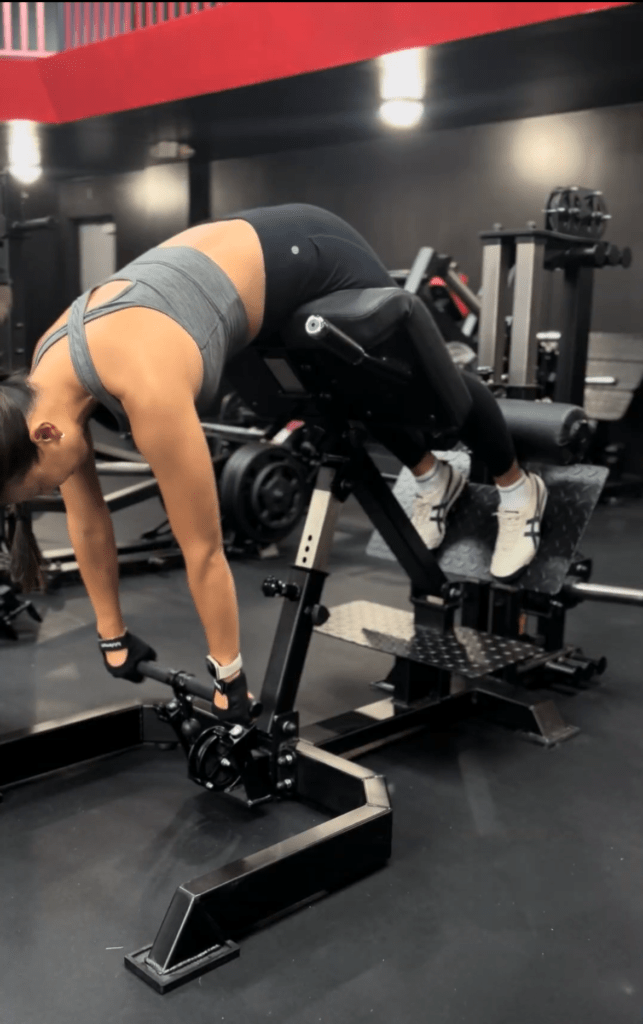
Train Your Hamstrings the Right Way at Fitness Factory KC
Strong hamstrings protect the knee, support lumbar spine health, improve athletic performance, and produce the kind of complete lower body development that carries over into every movement. At Fitness Factory KC, located at 10550 W 103rd St in Overland Park, KS, our NASM and NCSF certified personal trainers build every program around the biomechanical principles that produce real, lasting results. Whether your goal is strength, body composition, injury resilience, or competitive preparation, our trainers integrate EMG-informed exercise selection, proper loading patterns, and progressive programming into every session.
These ten hamstring workouts give you a scientifically grounded foundation for building stronger, more resilient legs. Apply them consistently, train both movement patterns each week, and let the science do the work.