Learning how to squat correctly starts with one idea. The squat is a hip and knee dominant movement that loads the quadriceps, glutes, adductors, hamstrings, and spinal erectors at the same time. Correct squat form means keeping the barbell or your center of mass stacked over the middle of the foot while the hips and knees flex together. When that line breaks, the joint that sits furthest from the load absorbs the stress. Master the line and the squat becomes the most productive lower body exercise you own.
Most people do not have a squat problem. They have a setup problem. Foot position, bracing, and depth are decided in the first two seconds of the rep, and every fault after that is a consequence. This guide breaks the squat down by joint, then gives you the top 10 squat exercises in the order a coach would actually teach them. Every cue below is used daily on the floor at Fitness Factory KC in Overland Park, KS.
The Biomechanics of a Correct Squat
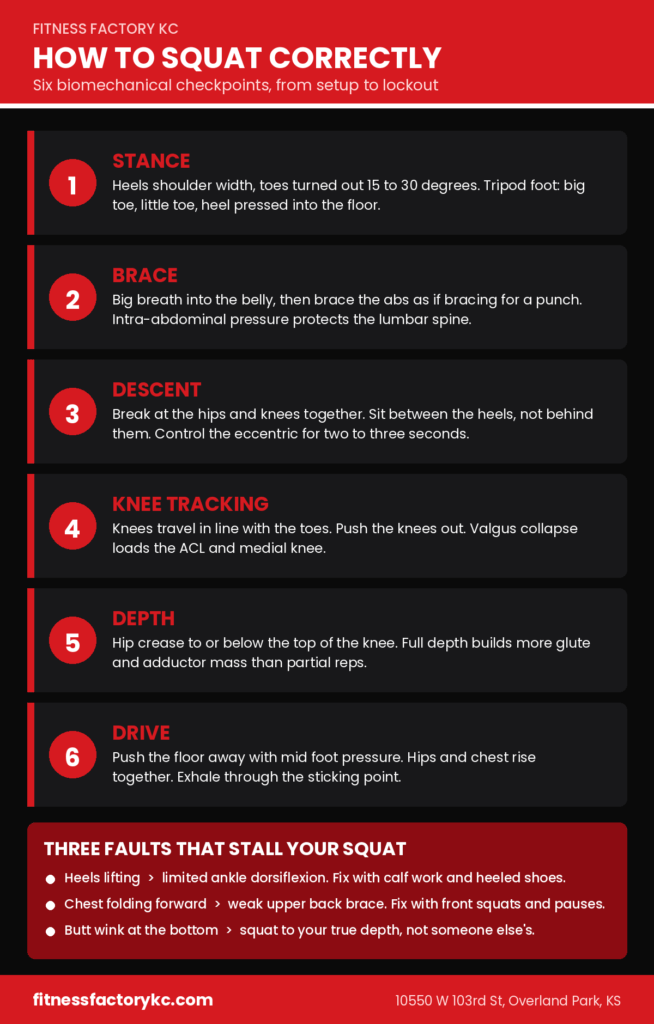
The squat is a closed chain, triple flexion movement. Ankle dorsiflexion, knee flexion, and hip flexion happen together on the way down. Then hip and knee extension reverse it on the way up. Your job is to keep the resistance vector stacked over the base of support, which is the mid foot.
1. Set the feet
Place your heels roughly shoulder width apart. Turn the toes out between 15 and 30 degrees. This external rotation opens the hip capsule and gives the femur room to travel into the pelvis, which is what allows depth without the lower back rounding. Grip the floor with three points: the base of the big toe, the base of the little toe, and the heel.
2. Brace before you move
Take a large breath into the abdomen, not the chest. Then tighten the abs as if you were about to take a punch. This is the Valsalva pattern, and it raises intra abdominal pressure so the trunk behaves like a rigid cylinder. A braced trunk is what keeps the lumbar spine neutral under load.
3. Descend with the hips and knees together
Break at the hips and knees at the same moment. Sit between your feet rather than reaching the hips backward, which turns the movement into a good morning. Lower under control for two to three seconds. The eccentric is where tension builds, and it is also where most form errors first appear.
4. Track the knees over the toes
The knees should travel in the same direction the toes point. Knee valgus, where the knees cave inward, increases strain on the ACL and the medial knee structures. The fix is rarely the knee itself. It is usually weak gluteus medius and a cue to push the knees out on the way down and the way up.
5. Hit real depth
Aim for the hip crease level with or slightly below the top of the knee. Deep squats produce greater glute and adductor activation than partial reps, and full range training builds more muscle across the leg than half reps at the same relative load. Depth is limited by your hip anatomy and ankle mobility, so your depth and someone else’s may not match.
6. Drive out of the hole
Push the floor away with even mid foot pressure. The hips and the chest must rise at the same rate. If the hips shoot up first, the load shifts to the lower back. Exhale as you pass the sticking point, usually just above parallel.
Common Squat Faults and What They Actually Mean
| Fault you see | Real cause | Fix that works |
|---|---|---|
| Heels lift off the floor | Limited ankle dorsiflexion | Calf and soleus stretching, heel elevated squats, lifting shoes |
| Knees cave inward | Weak glute medius, poor motor control | Banded squats, side lying abduction, cue knees out |
| Chest folds forward | Weak upper back and trunk brace | Front squats, pause squats, heavy carries |
| Lower back rounds at the bottom | Depth beyond available hip range | Squat to your true depth, build hip mobility |
| Hips rise before shoulders | Quad weakness relative to hips | Tempo squats, front squats, leg press accessory work |
Top 10 Squat Exercises, In Progression Order
Squat variations are not interchangeable. Each one changes the load position, and the load position decides which muscles work hardest. Move up the ladder only when the current rung looks clean for every rep.
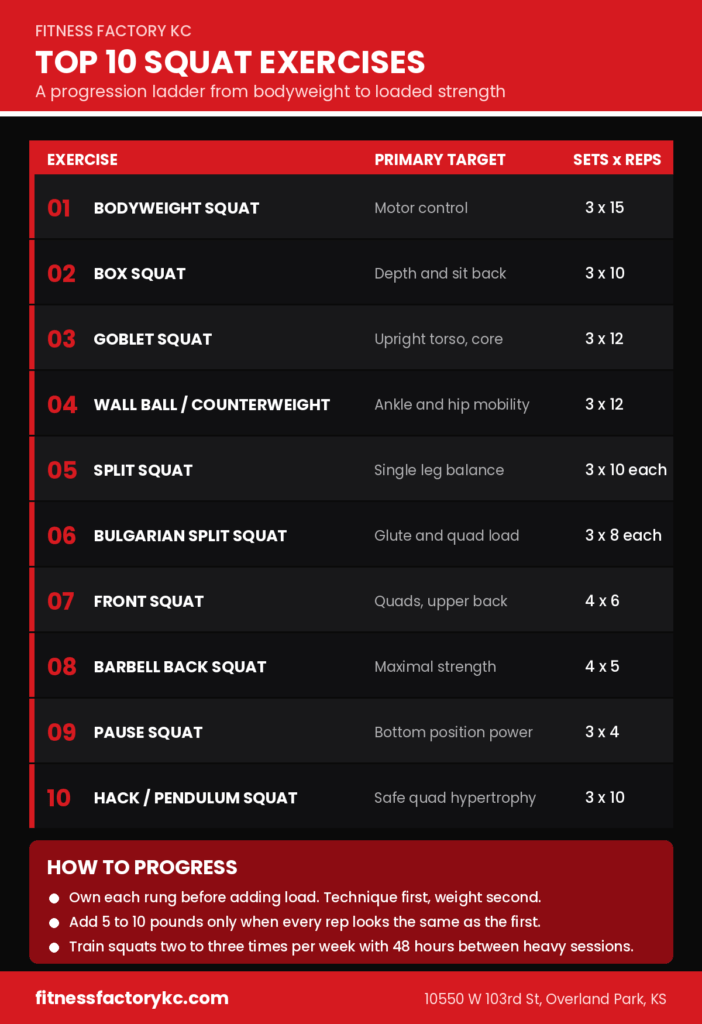
1. Bodyweight Squat. The foundation. It teaches the motor pattern with no external load, so you can chase depth and knee tracking without risk. Perform 3 sets of 15 controlled reps.
2. Box Squat. Sitting back to a box teaches hip loading and gives you a consistent depth target. It also helps trainees with knee pain, since the shin angle stays more vertical. Use 3 sets of 10.
3. Goblet Squat. Holding a dumbbell or kettlebell at chest height acts as a counterbalance. The anterior load forces an upright torso and switches on the trunk. This is the fastest way to clean up a squat. Use 3 sets of 12.
4. Counterweight or Wall Ball Squat. Holding a light plate at arm’s length lets you sink deeper than you can unloaded. Use it as a mobility drill before heavy work.
5. Split Squat. The first unilateral step. It exposes side to side strength differences and builds ankle stability. Perform 3 sets of 10 per leg.
6. Bulgarian Split Squat. Elevating the rear foot shifts most of the load onto the front leg, producing high glute and quad tension with a light dumbbell. Brutal and effective. Use 3 sets of 8 per leg.
7. Front Squat. The bar sits on the anterior deltoids, so the torso must stay vertical. This increases quadriceps demand and reduces shear on the lower back. Use 4 sets of 6.
8. Barbell Back Squat. The strength standard. High bar keeps the torso upright and hammers the quads. Low bar shifts the load posteriorly and lets you move more weight through the hips and posterior chain. Use 4 sets of 5.
9. Pause Squat. A two to three second pause at the bottom removes the stretch reflex. You are forced to produce concentric force from a dead stop, which builds power out of the hole. Use 3 sets of 4.
10. Hack Squat or Pendulum Squat. A machine based squat that fixes the bar path and lets you drive quad hypertrophy to failure with less trunk fatigue. An excellent finisher. Use 3 sets of 10.
How to Program Your Squats
- Train the squat pattern two to three times per week, with at least 48 hours between heavy sessions.
- Keep heavy work in the 4 to 6 rep range and accessory work in the 8 to 12 rep range.
- Add 5 to 10 pounds only when every rep in a set matches the quality of the first rep.
- Warm the ankles and hips before the first set. Cold joints cannot reach depth.
- Film a set from the side every few weeks. Your eyes lie. The camera does not.
Frequently Asked Questions About Squat Form
Is it bad for your knees if they go past your toes?
No. Forward knee travel is normal and necessary, especially in front squats and deep squats. Blocking it forces the hips backward and increases shear on the lower back instead. What matters is direction, not distance. Knees should track over the toes, never collapse inward.
How deep should you squat?
Squat until the hip crease reaches the top of the knee or slightly below, provided you can hold a neutral spine there. Depth is capped by hip socket anatomy and ankle dorsiflexion, so your end range is personal. If the pelvis tucks under at the bottom, you have passed your usable depth.
Are squats bad for your knees?
Correctly performed squats are protective. Loading through full range strengthens the quadriceps, patellar tendon, and surrounding connective tissue, which improves joint tolerance. Knee pain in the squat usually traces back to valgus collapse, excessive load, or poor tempo control, not the movement itself.
How many squats should you do a day?
Daily squatting is unnecessary for most people. Train the squat pattern two to three times per week and allow 48 hours between heavy sessions so the tissue can recover. Roughly 10 to 20 hard working reps per heavy session is enough to drive strength gains.
Why do my heels lift when I squat?
Limited ankle dorsiflexion is the usual culprit. When the shin cannot travel forward far enough, the body compensates by rolling onto the toes. Work on calf and soleus mobility, elevate the heels on a small plate, or use lifting shoes while the range improves.
Should beginners squat with a barbell?
Not on day one. Own the bodyweight squat for multiple sets of 15 clean reps, then move to goblet squats. The goblet position teaches an upright torso and a braced core, which transfers straight to the barbell back squat later.
What muscles do squats work?
Squats load the quadriceps, gluteus maximus, adductor magnus, and hamstrings as prime movers. The spinal erectors, abdominals, and upper back work isometrically to hold the trunk rigid. Stance width and bar position shift the emphasis between quads and posterior chain.
Train Your Squat With Us at Fitness Factory KC
Fitness Factory KC is a 24 hour gym in Overland Park, KS built for people who want more than a place to check in. We pair premium racks, platforms, and free weights with certified coaches who fix your squat in person, rep by rep. Members train across the Kansas City metro, from Overland Park to Leawood and Lenexa, on their own schedule, day or night.
Ready to build a squat that holds under load? Book a free tour of our Overland Park facility or claim a free personal training kickstart session