To get bigger arms, you need to train both the biceps and triceps with a mix of heavy compound lifts and targeted isolation work, load each muscle in its stretched position, and apply progressive overload week after week. The triceps make up close to two-thirds of your upper arm mass, so they deserve at least as much attention as the biceps. The exercises below are organized by their biomechanical role, from overall arm size to the peak of the biceps and the horseshoe shape of the triceps. Each one is chosen for how it loads the muscle through its full range, not just how it feels in the moment.
Bigger arms come down to three drivers: mechanical tension, enough weekly volume for both muscle groups, and a full range of motion that loads each muscle where it is longest. Curls build the front of the arm, extensions build the back, and both respond best when you control every rep and treat clean technique as more important than the weight on the bar. Train your arms two times per week, keep most working sets in the 8 to 15 rep range, and add load or reps over time. Do that consistently, and both the biceps and triceps have a clear reason to grow.
The 10 Best Arm Exercises: Quick Reference
- Barbell Curl
- Incline Dumbbell Curl
- Hammer Curl
- Preacher Curl
- Cable Curl
- JM Press
- Overhead Cable Triceps Extension
- Skull Crusher
- Triceps Pushdown
- Dips
Understand Your Arm Anatomy First
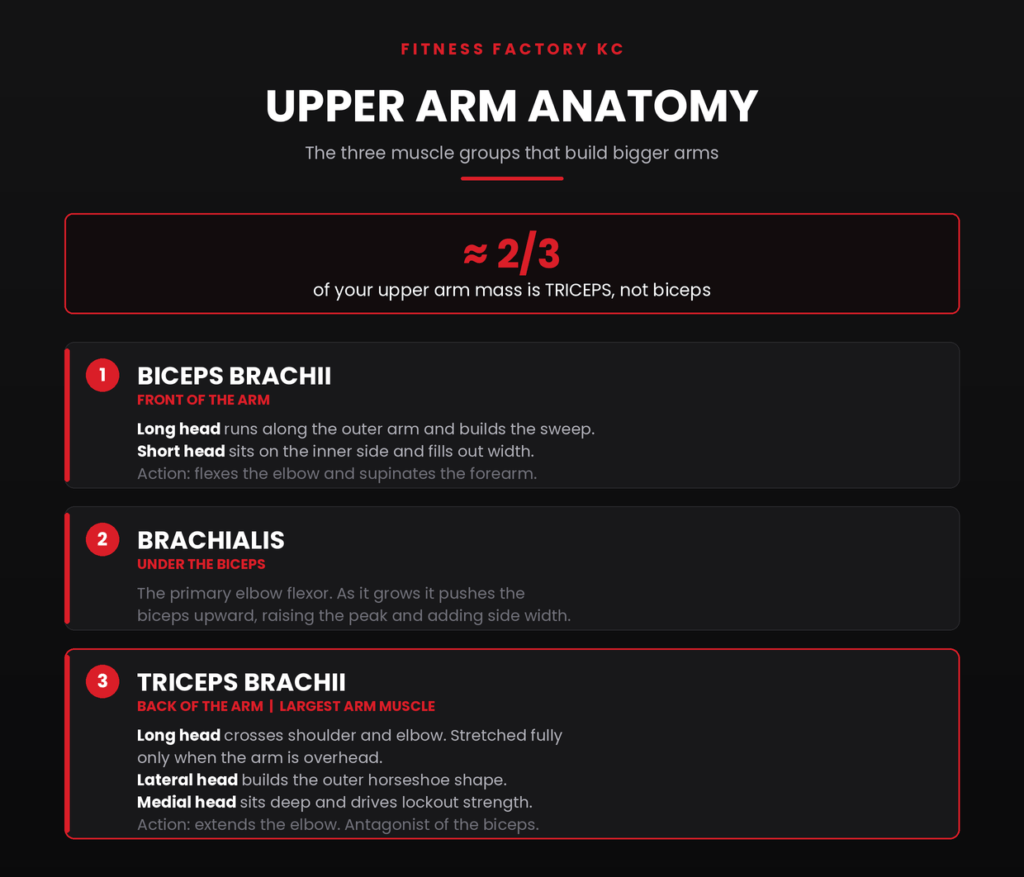
Your upper arm is built from three muscle groups, and each has a distinct line of pull. Training all three is the difference between flat arms and thick, three-dimensional ones.
Biceps brachii:
The biceps sit on the front of the upper arm and have two heads. The long head runs along the outer arm, and the short head sits on the inner side. The muscle flexes the elbow and supinates the forearm, which means it turns the palm upward. It is a strong supinator but a relatively weak elbow flexor on its own.
Brachialis:
This muscle lies underneath the biceps and is the primary elbow flexor. As it grows, it pushes the biceps upward and increases the visible peak. It also adds width when the arm is viewed from the side, so it deserves direct work.
Triceps brachii:
The triceps occupy the entire back of the upper arm and account for roughly two-thirds of its total mass. The muscle has three heads. The long head crosses both the shoulder and the elbow, while the lateral and medial heads cross only the elbow. Because of this, the long head is stretched fully only when your arm is overhead.
Most lifters overtrain the biceps and undertrain the triceps because the biceps are what you see in the mirror. Balanced exercise selection fixes that imbalance and gives you more total arm size for the same effort.
Best Exercises for Bigger Biceps
The biceps respond to direct loading through a long range, and to variations that shift the arm behind the body to stretch the long head.
1. Barbell Curl.
Curl a barbell from a full stretch at the bottom to full elbow flexion at the top while keeping your elbows fixed at your sides. The barbell lets you load more total weight than dumbbells, which makes it your main driver for biceps mass and strength. Research using an EZ bar found higher biceps and brachioradialis activation than a straight bar for many lifters, so use whichever grip keeps your wrists comfortable and lets you add load over time.
2. Incline Dumbbell Curl.
Lie back on an incline bench and let your arms hang straight down, then curl the dumbbells without letting your elbows drift forward. The reclined position pulls your arms behind your torso, which lengthens the long head of the biceps under load. EMG work shows the incline curl keeps the biceps working through the whole range, unlike some fixed positions where tension drops off. This is one of the best movements for the outer sweep of the arm.
3. Hammer Curl.
Curl with a neutral grip, thumbs pointing up, and keep the palms facing each other throughout. This grip shifts work onto the brachialis and brachioradialis, the muscles that sit under and beside the biceps. Because the brachialis pushes the biceps up as it grows, hammer curls add thickness and a taller peak that a standard curl alone cannot build.
4. Preacher Curl.
Rest the back of your upper arms on a preacher pad and curl from a near-full stretch. Bracing the arms removes momentum and forces the elbow flexors to do the work at the bottom of the range, where the muscle is most challenged. A barbell or dumbbell version that loads the stretched position tends to build more muscle than a setup that only loads the top.
5. Cable Curl.
Curling against a cable keeps steady tension on the biceps from the bottom of the rep to the top, the exact place where free weights go light. Set the pulley low and keep your elbows pinned to load the muscle through its full working range. Use a slow, controlled tempo and let the biceps, not your lower back, move the weight.
Best Exercises for Bigger Triceps
The triceps are the largest muscles in the arm, so serious arm size depends on training them hard. The long head grows best when loaded in the overhead, stretched position.
6. JM Press.
Lie on a bench with a shoulder-width grip and lower the bar toward the base of your neck on a path that bends the elbow and travels the bar back at the same time, then press it away to lockout. The JM press sits between a close grip bench press and a skull crusher, which lets you load the triceps under a heavy barbell while the elbow stays flexed at the bottom. That combination places all three heads under high mechanical tension in a lengthened position, something a pure pressing movement never does. Keep your elbows tucked, stop the bar just short of your throat, and treat the bottom as a controlled pause rather than a bounce. Once your technique is set, it becomes the heaviest triceps builder in the arm session, and the lockout strength carries straight over to your bench press.
7. Overhead Cable Triceps Extension.
Extend your arms overhead against a cable so the elbows finish straight above your head. A controlled study using MRI found that training the triceps in the overhead position produced substantially more growth than training with the arm at the side, with the long head gaining around 40 percent more size. Raising the arm overhead stretches the biarticular long head across both the shoulder and elbow, which is why this position drives so much growth. Make it a staple, not an afterthought.
8. Skull Crusher.
Lie on a bench and lower a barbell or EZ bar toward your forehead or just behind your head, then extend back to lockout. Lowering behind the head increases the stretch on the long head and keeps constant tension across all three heads. Keep the upper arms angled slightly back rather than straight up so the triceps stay loaded at the bottom.
9. Triceps Pushdown.
Push a bar or rope down against a cable while keeping your elbows fixed at your sides. The pushdown loads the lateral and medial heads hard in the shortened position and is easy to perform with clean form. It pairs well with an overhead movement, since the two cover different points of the strength curve. Use it to add volume and a strong contraction at the end of a session.
10. Dips.
Lower your body between parallel bars until your elbows reach about 90 degrees, then press back to lockout. Staying upright shifts the load onto the triceps rather than the chest. Dips let you add bodyweight plus extra load, which makes them a powerful compound builder for the back of the arm once you have the shoulder mobility to perform them safely.
Best Arm Exercises by Muscle Target
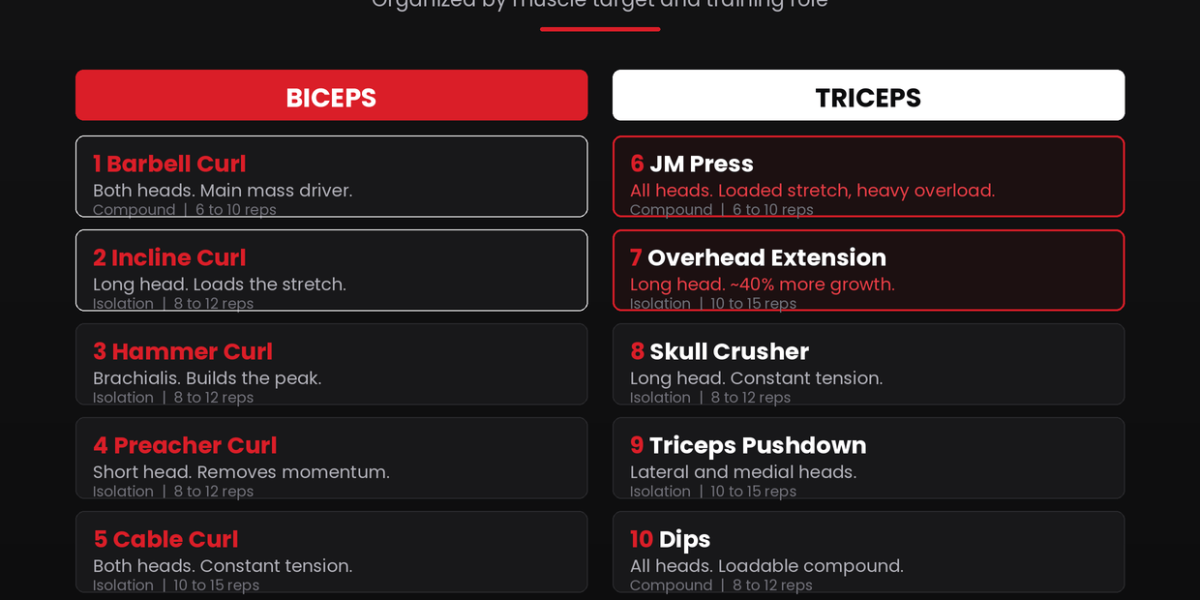
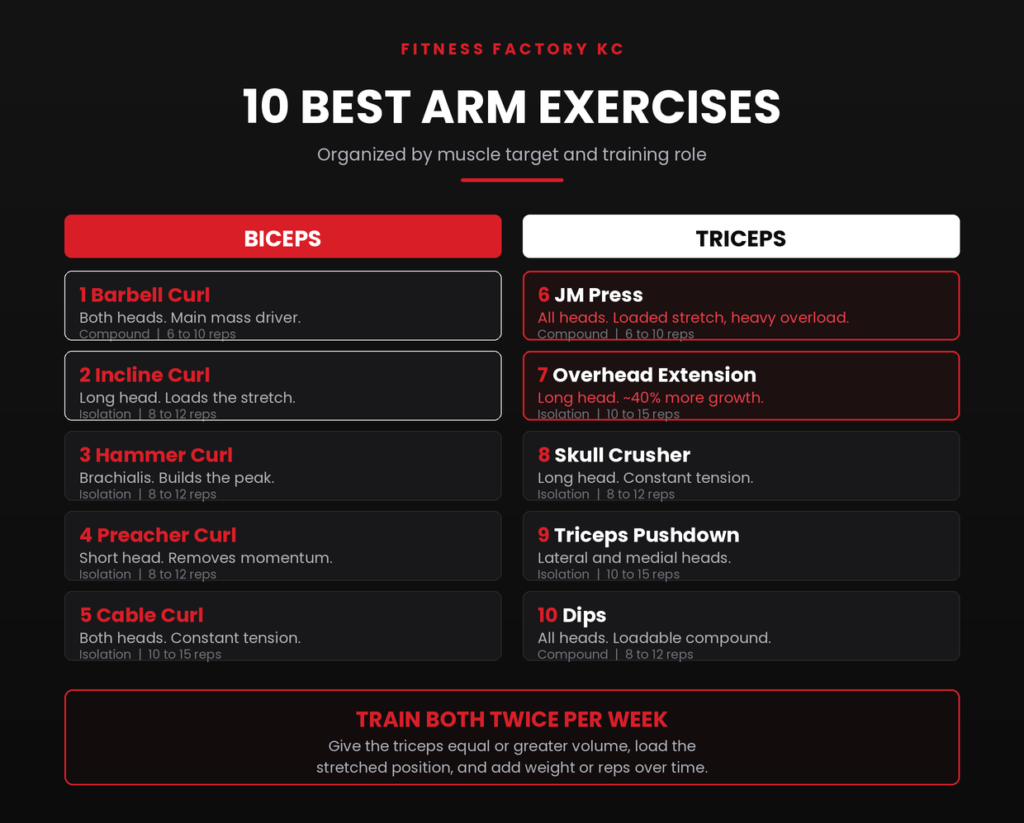
| Exercise | Primary Target | Type | Suggested Reps |
|---|---|---|---|
| Barbell Curl | Biceps (both heads) | Compound | 6 to 10 |
| Incline Dumbbell Curl | Biceps long head | Isolation | 8 to 12 |
| Hammer Curl | Brachialis, brachioradialis | Isolation | 8 to 12 |
| Preacher Curl | Biceps short head, brachialis | Isolation | 8 to 12 |
| Cable Curl | Biceps (both heads) | Isolation | 10 to 15 |
| JM Press | Triceps (all heads, long head emphasis) | Compound | 6 to 10 |
| Overhead Cable Extension | Triceps long head | Isolation | 10 to 15 |
| Skull Crusher | Triceps long head | Isolation | 8 to 12 |
| Triceps Pushdown | Triceps lateral, medial | Isolation | 10 to 15 |
| Dips | Triceps (all heads) | Compound | 8 to 12 |
Sample Arm Workout
Here is how these movements come together in one balanced session that hits both muscle groups:
- Warm-Up: Five to ten minutes of light cardio plus a few light sets of curls and pushdowns to prime the elbows.
- JM Press: Four sets of 6 to 10 reps.
- Barbell Curl: Four sets of 6 to 10 reps.
- Overhead Cable Triceps Extension: Three sets of 10 to 15 reps.
- Incline Dumbbell Curl: Three sets of 8 to 12 reps.
- Triceps Pushdown: Three sets of 10 to 15 reps.
- Hammer Curl: Two sets of 10 to 12 reps to finish.
Tips to Get Bigger Arms Faster
Train the triceps at least as hard as the biceps. The triceps are the larger muscle, so they carry most of your arm size. Give them equal or greater volume.
Load the stretched position. Movements like the incline curl, the JM press, and the overhead extension place the muscle under tension where it is longest, which is a strong driver of growth. Prioritize them.
Apply progressive overload. Add weight, reps, or sets over time so the muscle keeps adapting. Track your lifts and aim to beat your last session. A structured approach to your training keeps that progress steady.
Use the full range of motion. Curl and extend through the complete range on every rep rather than cutting the movement short. Partial reps leave size on the table.
Control the eccentric. Lower the weight slowly on both curls and extensions. The lengthening phase creates much of the mechanical tension that builds muscle.
Eat enough protein. Muscle repair depends on adequate protein and overall nutrition. Aim for a consistent daily intake spread across meals.
Respect recovery. Muscle grows during rest, not during the session. Leave at least 48 hours between hard arm sessions and prioritize recovery and sleep.
Fix stalls with a plan. If your arms stop responding, adjust volume, exercise selection, or intensity rather than adding random sets. A smart method to break through a plateau keeps growth on track.
Frequently Asked Questions
How often should I train my arms to grow them?
Training your arms two times per week works well for most people. The arms also get indirect work from pressing and pulling, so leave at least 48 hours between dedicated sessions.
Should I train biceps and triceps together?
Yes. Training them in the same session is efficient and balanced, since one flexes the elbow and the other extends it. Pairing a curl with an extension also lets one muscle rest while the other works, which keeps the session moving.
Why are my arms not growing?
The most common reasons are too little triceps volume, no progressive overload, and cutting the range of motion short. Fix the volume balance, add load over time, and train each muscle through its full range, especially the stretched position.
Do I need heavy weights for bigger arms?
You need enough load to challenge the muscle within your chosen rep range, but form matters more than the number on the weight. Sets taken close to failure in the 6-to-15 rep range with clean technique build arm size effectively.
Is the JM press better than the close grip bench press for triceps?
For arm size, yes. The close grip bench splits the load across the chest and front delts, while the JM press keeps the elbow flexed at the bottom and holds the triceps under tension in a lengthened position. Start light, since the bar path takes practice.
Can I build bigger arms at home?
Yes. A pair of adjustable dumbbells covers curls, hammer curls, overhead extensions, and skull crushers. By changing the angle, rep range, and applying progressive overload, you can train both the biceps and triceps at home.
Build Bigger Arms at Fitness Factory KC
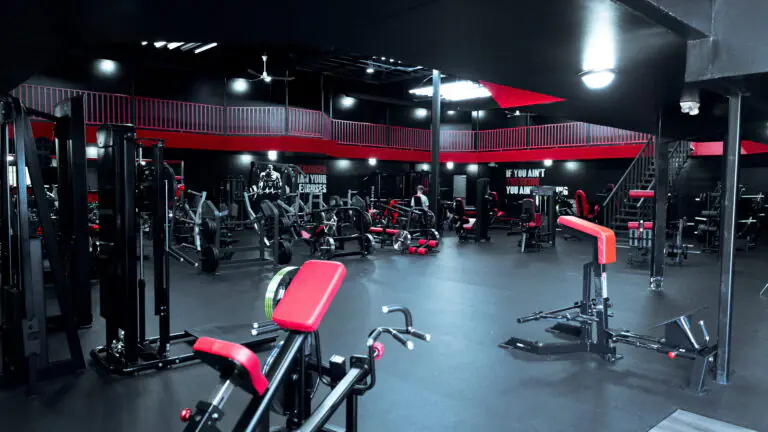
Bigger, stronger arms come from consistent training, balanced volume for the biceps and triceps, and clean technique rooted in sound movement biomechanics. Arm development also pairs naturally with strong, capped shoulders for a complete upper body. At Fitness Factory KC, our gym in Overland Park is stocked with the barbells, dumbbells, cables, and machines you need to train every head of the biceps and triceps anytime your schedule allows. If you want a plan built around your goals and hands-on coaching on your form, explore our personal training options or join one of our gym memberships today.