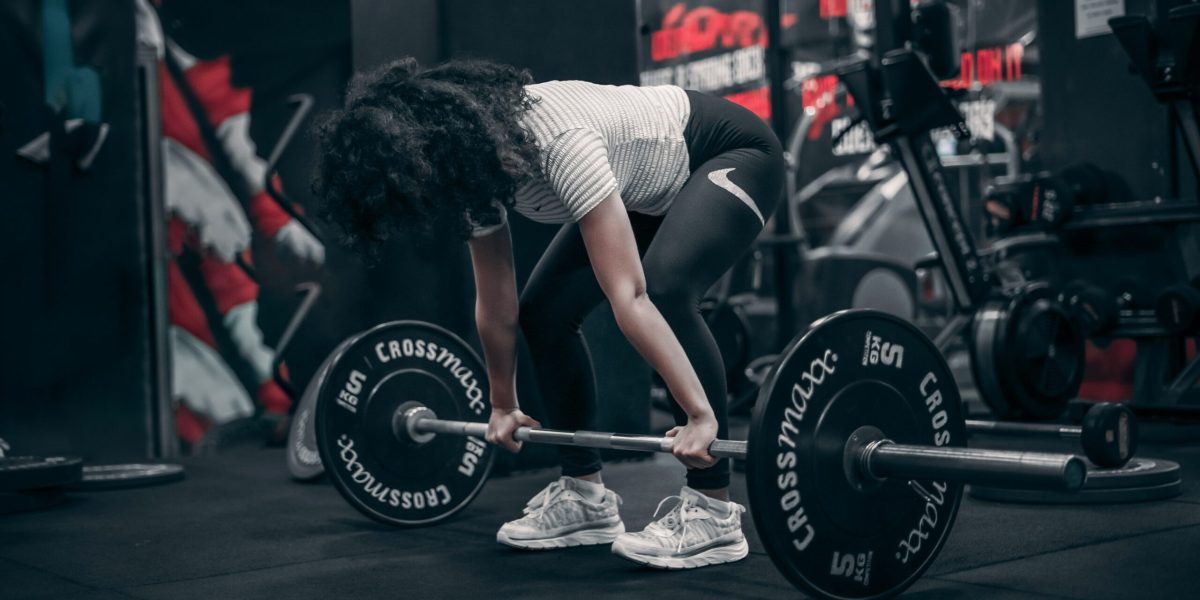
Learning how to deadlift with proper form is the difference between a lift that builds a resilient posterior chain and one that leaves your lower back sore for three days. The conventional barbell deadlift is a hip hinge under load. Your hips travel backward, your knees bend enough to let the shins meet the bar, and your spine holds a braced neutral position while the hip and knee extensors do the work. Every cue below serves that one goal: keep the load close to your center of mass and keep the spine out of the equation.
Form matters here more than in almost any other lift because of leverage. Spinal compression rises sharply as the bar drifts forward of the midfoot, since the horizontal distance between the load and the L4 to L5 segment lengthens the moment arm. A bar two inches farther out is not two inches of extra effort. It is a measurable increase in shear and compression on every rep. At Fitness Factory KC in Overland Park, coaches spend the first session of any strength block on setup because position dictates how much force reaches the muscles you want to train.
What the Deadlift Trains
The deadlift is a hip dominant compound movement. Electromyography studies consistently place the highest activation in the erector spinae, gluteus maximus, hamstrings, and quadriceps, with substantial demand on the trapezius, latissimus dorsi, and the entire grip chain.
| Region | Primary role in the lift |
|---|---|
| Gluteus maximus and hamstrings | Hip extension from the floor through lockout |
| Quadriceps | Knee extension during the initial break from the floor |
| Erector spinae | Isometric resistance against spinal flexion |
| Latissimus dorsi | Keeps the bar pinned close to the body |
| Forearm flexors | Grip endurance across the set |
Note that the erectors work isometrically. They are not meant to move your spine during the rep. They are meant to stop it from moving.
The Setup: Position Before Power
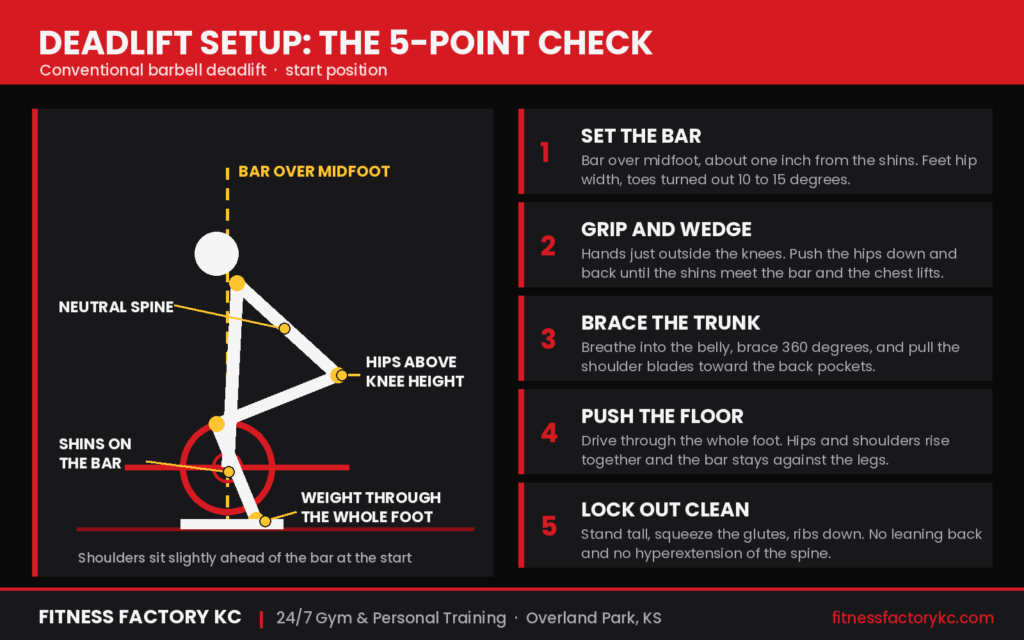
Walk to a loaded bar and place your feet hip width apart, roughly the stance you would jump from, with your toes turned out ten to fifteen degrees. The bar should sit over your midfoot, about an inch from your shins. This is the balance point of the foot and the line the bar needs to travel in.
Hinge at the hips and reach down without dropping your chest. Take a double overhand grip just outside your knees so your arms hang vertically. Now bend the knees forward until your shins contact the bar. Your hips should settle above knee height and below shoulder height, which places your shoulders slightly ahead of the bar. That shoulder position is not a mistake. It is what allows the bar to break the floor in a straight vertical line rather than swinging out.
Before you pull, do two things. Breathe into your belly and brace the trunk in all directions, which raises intra abdominal pressure and stiffens the lumbar spine. Then pull the slack out of the bar by squeezing your lats and taking tension into your arms until you hear the plates settle. A slack pull forces your body to absorb the load in a position it did not choose.
Executing the Pull
Push the floor away rather than yanking the bar upward. The mental switch matters because it recruits the legs at the start, when knee extension contributes most.
- Hips and shoulders rise at the same rate through the first third of the lift
- The bar stays in contact with the shins and then the thighs
- The back angle holds constant until the bar clears the knees
- Once past the knee, drive the hips forward to finish the movement
- Lock out standing tall with the glutes squeezed and the ribs pulled down
Do not lean back at the top. A backward lean at lockout shifts load into the facet joints and adds nothing to the lift. The finish position is a straight line from ear to shoulder to hip to ankle.
The descent is a controlled reversal, not a drop. Push the hips back first, let the bar track down the thighs, and once it clears the knees, bend them to return the plates to the floor. Every rep of a set should start from a dead stop. The word dead in deadlift refers to that dead stop, and bouncing the plates removes the hardest and most useful part of the lift.
Five Form Faults and How to Fix Them
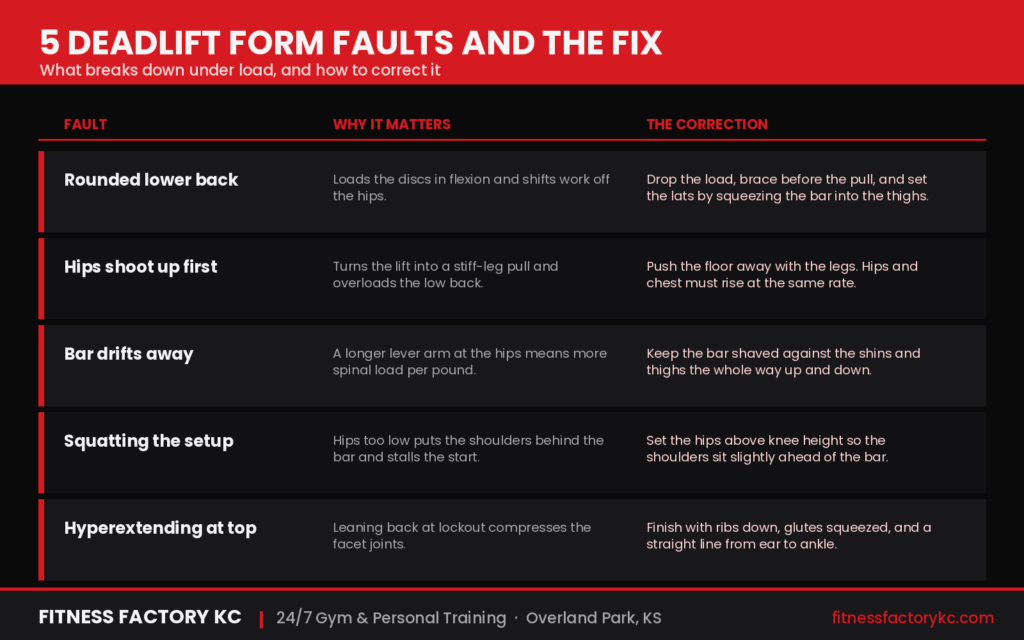
Most technical breakdowns are not mysteries. They are predictable responses to a load that exceeds current positional strength.
| Fault | What is happening | Correction |
|---|---|---|
| Rounded lumbar spine | Trunk bracing fails and the hips lose their pulling position | Reduce load by twenty percent and rebuild with paused reps below the knee |
| Hips rise before the bar | Quadriceps cannot support the starting knee angle | Add front squats and pause deadlifts at two inches off the floor |
| Bar drifts forward | Lats disengage and the moment arm lengthens | Cue armpits over the bar and practice slow eccentric reps |
| Hips set too low | The lift becomes a squat with a bar too far in front | Reset with hips above knee height so the shoulders sit ahead of the bar |
| Hyperextending at lockout | Habitual finish rather than a strength issue | Finish with ribs down and hold the top for one full second |
If two or more of these appear in the same set, the set was too heavy. That is a programming answer, not a technique answer.
Choosing a Variation
Conventional deadlifting suits most people, but limb proportions and training history change what feels efficient.
| Variation | Best suited to | Main difference |
|---|---|---|
| Conventional | General strength, most body types | Greater hip extension demand and longer range |
| Sumo | Longer torso, shorter arms, hip mobility available | Wider stance shortens range and reduces trunk lean |
| Trap bar | Beginners and athletes returning from back issues | Load sits in line with the body, reducing spinal shear |
| Romanian | Hamstring hypertrophy and hinge practice | Starts at the top, no floor contact, knees stay soft |
| Block or rack pull | Working the lockout portion | Shorter range with heavier overload |
Beginners often progress fastest on a trap bar or an elevated conventional pull, then move to the floor once the hinge holds under load. Trainers at Fitness Factory KC frequently run new lifters through four to six weeks of trap bar work before switching to the barbell.
Programming Deadlifts Sensibly
Deadlifts are systemically demanding. Most lifters do best with one heavy session per week plus one lighter hinge variation. Sets of three to six repetitions build strength efficiently while keeping technique intact, since form degrades late in high repetition sets. Stop a set when bar speed drops noticeably or when your back angle changes. Warm up with the movement itself, using two or three progressively heavier sets before your working weight.
Frequently Asked Questions
Should my back be completely flat when I deadlift?
Neutral, not flat. The lumbar spine has a natural lordotic curve and the goal is to maintain it under load rather than force the back into a straight line. Slight thoracic rounding is common in experienced lifters and is generally tolerated. Progressive lumbar flexion during a rep is the pattern to correct.
Is sumo or conventional deadlifting better?
Neither is superior in general terms. Sumo shortens the range of motion and reduces trunk lean, which lowers spinal extensor demand, while conventional places more work on the hips and back. Anthropometry decides which is more efficient for you. Torso length, femur length, and arm length all matter more than preference.
How much should I be able to deadlift?
Untrained adults typically start below bodyweight. A reasonable intermediate benchmark is one and a half times bodyweight for men and around one and a quarter times bodyweight for women, though training age and body composition shift these figures considerably. Chasing a number before you own the position is the most common reason lifters stall.
Do I need a lifting belt or straps?
Not at submaximal loads. A belt gives the abdominal wall something to brace against and can raise intra abdominal pressure at heavy weights, but it does not replace the bracing skill itself. Straps solve grip failure so you can train the target muscles, though keeping some sets strapless preserves grip strength.
My lower back is sore after deadlifting. Is that normal?
Mild muscular soreness in the erectors is expected after a new stimulus and usually resolves within forty eight hours. Sharp pain, pain that centralizes near the spine, or symptoms travelling into a leg are different signals entirely and warrant assessment by a qualified professional before you load the pattern again.
Can beginners deadlift safely?
Yes, with coaching and appropriate loading. The lift replicates a movement people perform daily, so learning it under supervision has value beyond the gym.
Train the Lift With Someone Watching
Reading about hip position and feeling it are different things. Fitness Factory KC is a 24 hour gym in Overland Park, Kansas, with platforms, quality bars, and certified coaches who run form checks as part of every personal training session. To get your deadlift assessed before you add weight, book a free session or a facility tour at fitnessfactorykc.com.