

Learning how to bench press safely and effectively begins with one idea: the barbell bench press is a shoulder joint exercise before it is a chest exercise. Load travels through the glenohumeral joint on every rep. The position of your shoulder blades, elbows and wrists decides whether that force reaches the pectoralis major and triceps brachii, or lands on connective tissue built to absorb far less.
Safe technique and strong technique are the same technique. A retracted scapula, a stacked wrist and a controlled eccentric phase reduce joint stress while improving force transfer. Biomechanical research shows grip width and shoulder abduction angle change how load is shared between the shoulder and the elbow. Those details decide what your body absorbs over years of pressing.
Set Up Before You Load the Bar
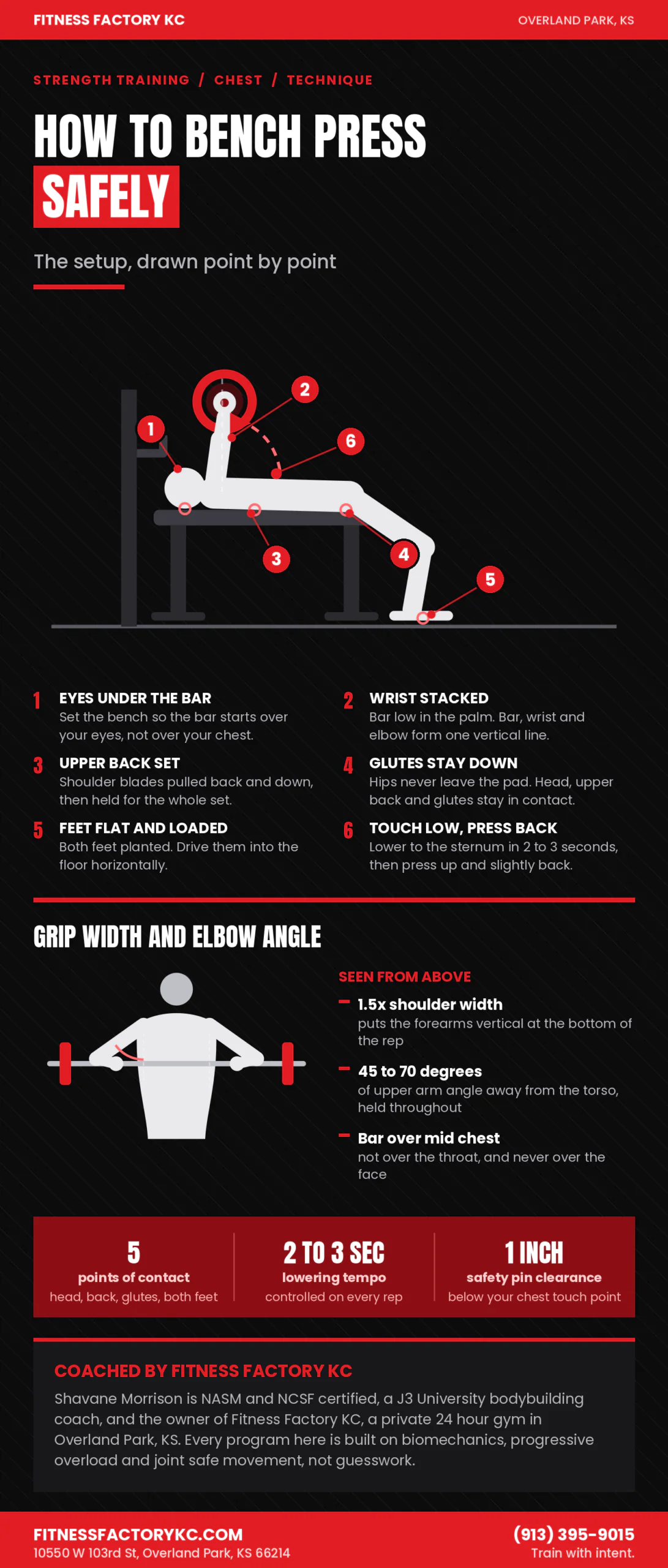
- Bench inside a rack. Set the safety pins one inch below your chest touch point.
- Check both J hooks sit level and fully seated.
- Set bar height so your elbows stay slightly bent at the un rack.
- Load plates in matched pairs on a stable bench.
- Warm up the rotator cuff with band pull aparts, then ramp two sets.
How to Bench Press with Proper Form
- Set your eye line. Lie back so the bar sits over your eyes. Too far forward and the un rack becomes a front raise.
- Lock five points of contact. Head, upper back and glutes on the bench, both feet flat on the floor.
- Set the scapula. Pull the shoulder blades back and down and hold them. This centers the humeral head and shortens the bar path. Do not shrug toward your ears.
- Build the grip. Around 1.5 times shoulder width puts the forearms vertical at the bottom. Sit the bar low in the palm so bar, wrist and elbow stack.
- Lower with intent. Take two to three seconds to the lower sternum, upper arms 45 to 70 degrees from the torso. Touch the chest on every working rep without collapsing onto it, since the bottom position is where strength is built.
- Press up and slightly back. Drive on a shallow diagonal so the lockout finishes over the shoulder joint. Re rack a locked out rep and feel both hooks seat.
Breathe in before the bar leaves the hooks and hold through the hardest part of the press. Drive the feet horizontally into the floor, not upward, so the hips stay down.
Grip Width and Elbow Angle
| Grip width | Effect on muscles and joints | Best for |
|---|---|---|
| Narrow, near shoulder width | Larger elbow moments, more triceps brachii and anterior deltoid activity | Sensitive shoulders, higher rep work |
| Medium, about 1.5 times shoulder width | Balanced shoulder and elbow moments, vertical forearm | The default for most lifters |
| Wide, near two times biacromial width | Larger shoulder moments, shorter bar path, higher 1RM potential | Trained powerlifters only |
Wide grips with the arms near 90 degrees of abduction give the strongest single lift and the highest shoulder load. Reported bench press injuries include distal clavicular osteolysis, rotator cuff irritation and pectoralis major rupture, the last occurring with the arm extended and externally rotated under heavy load. A moderate grip with 45 to 70 degrees of tuck keeps the performance without the exposure.
Common Mistakes and How to Fix Them
| Mistake | Why it is risky | The fix |
|---|---|---|
| Bouncing the bar off the chest | Peak force hits the pectoral tendon at full stretch | Touch, pause, then drive |
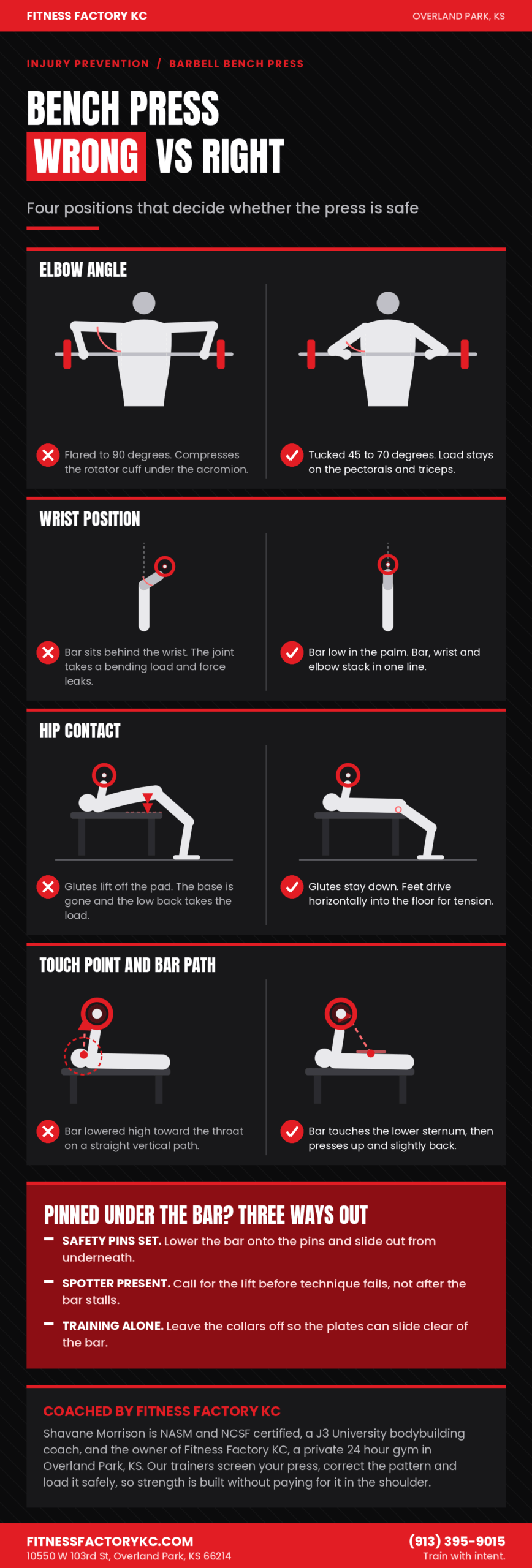
| Elbows flared to 90 degrees | Compresses rotator cuff tendons under the acromion and loads the AC joint | Hold 45 to 70 degrees of tuck |
| Bent wrists | The bar sits behind the wrist and leaks force | Grip low in the palm and stack the joints |
| Hips leaving the bench | Replaces a stable base with lumbar extension under load | Keep the glutes down, drive the feet horizontally |
| Failure with no safeties | A failed rep pins the bar on the chest or throat | Use pins, a spotter, or a safer variation |
Benching Without a Spotter
Set the safety pins one inch below your touch height and test them with an empty bar. With no safeties, leave the collars off so plates can slide clear. Stop one to two reps short of failure, and save maximum effort for dumbbells or machines.
Programming the Press
| Goal | Load | Sets and reps | Notes |
|---|---|---|---|
| Learn the pattern | 40 to 60 percent of 1RM | 3 to 4 x 5 to 8 | Identical reps before added weight |
| Hypertrophy | 65 to 80 percent | 3 to 5 x 6 to 12 | Stop 1 to 2 reps short |
| Maximal strength | 80 to 92 percent | 4 to 6 x 2 to 5 | Safeties or a spotter |
Add 2.5 to 5 pounds only when every rep in a set looks the same. Press two or three times per week, with 48 hours between heavy days, and match it with rows and face pulls. Scapular control keeps shoulders healthy across years of pressing. Pair the barbell with our best dumbbell chest exercises.
Frequently Asked Questions
Should the bar touch my chest every rep?
Yes for most lifters. Full range of motion builds strength in the bottom position. Touch under control rather than dropping.
Is arching my back safe?
A small natural arch helps set the shoulder blades and the glutes stay on the bench. Extreme arching is a competition skill that needs coaching.
Why do my shoulders hurt when I bench press?
Usually elbow flare, a grip that is too wide, a scapula that never gets set, or volume outpacing recovery. Fix the setup first. If pain continues, stop pressing and see a medical professional.
About Fitness Factory KC
Shavane Morrison brings seven years of personal training experience to every session. He is certified through NASM and NCSF, coaches bodybuilding through J3 University, and holds specializations in women’s fitness and Pilates plus Rock Tape certifications in IASTM, cupping and taping. His background in Health and Physical Education shapes a biomechanically driven approach.