Grip and forearm strength is the foundation of nearly every pull, hold, and carry your body performs, and building it is one of the fastest ways to unlock heavier lifts, better daily function, and thicker, more resilient arms. Your grip is the point where force leaves your body and enters the bar, the door handle, or the kettlebell. When that connection is weak, the strongest back and biceps in the world still fail. The old saying holds up under biomechanical scrutiny: you are only as strong as your weakest link, and for most lifters that link runs from the elbow to the fingertips.
The reason grip and forearm training deserves dedicated attention is simple. Your forearms drive every rowing, hanging, and holding movement, so weakness here quietly caps your performance on deadlifts, pull-ups, and carries long before your prime movers give out. Research also connects grip strength to broad measures of health. Studies link a stronger grip to lower mortality risk, better metabolic markers, and healthier blood pressure, which is why clinicians often measure it with a dynamometer as a marker of overall function. Train your grip and you get a stronger body and a stronger case for longevity.
The Anatomy Behind a Strong Grip
The forearm is not one muscle. It is a network of more than fifteen muscles that flex, extend, and rotate the wrist and fingers. Understanding this anatomy makes your training far more targeted.
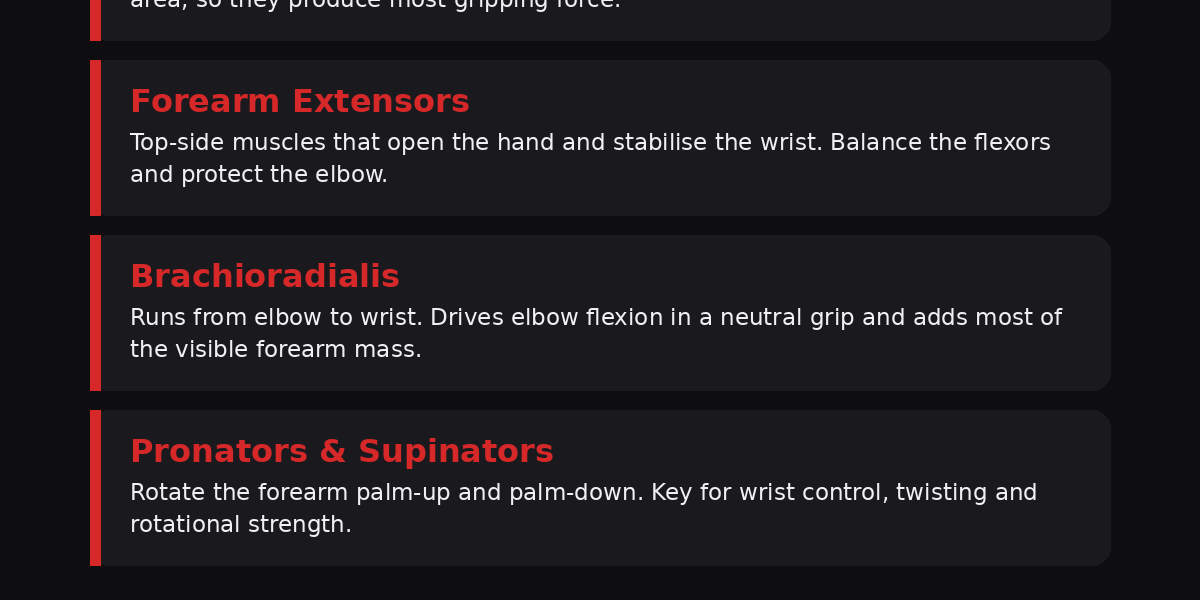
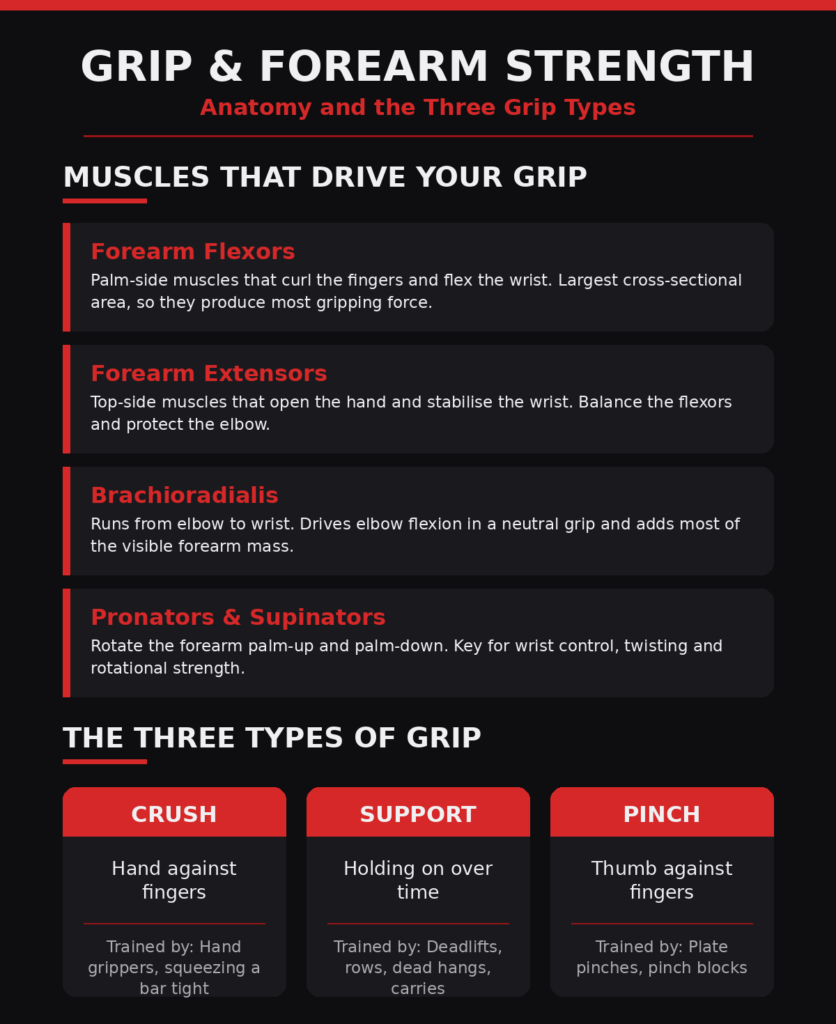
The flexors on the palm side, led by the flexor digitorum superficialis and profundus, curl the fingers and flex the wrist. Because their combined cross-sectional area is larger than every wrist extensor muscle put together, they generate most of your crushing and holding force. The extensors on the top side open the hand and stabilise the wrist, balancing the flexors and protecting the elbow from overuse strain. The brachioradialis runs from the upper arm to the wrist, drives elbow flexion in a neutral grip, and contributes most of the visible forearm mass. Finally, the pronators and supinators rotate the palm up and down, governing the rotational strength you use to open jars, swing tools, or win an arm wrestle.
The Three Types of Grip
Grip strength is not a single quality. Training all three types builds a hand that performs in every situation.
| Grip type | What it measures | How to train it |
|---|---|---|
| Crush | Force between palm and fingers | Hand grippers, squeezing a thick bar hard |
| Support | How long you can hold on | Deadlifts, rows, dead hangs, farmer’s carries |
| Pinch | Force between thumb and fingers | Plate pinches, pinch blocks |
Most lifters care most about support grip, since it limits deadlifts, rows, and carries. Crush grip shows up when you squeeze a gripper or crush a can, and pinch grip appears every time you hold a plate flat or lift something wide. A complete program touches all three.
Best Grip and Forearm Exercises
You do not need specialised equipment to build a serious grip. A barbell, dumbbells, and a pull-up bar cover most of the work, though grippers and a wrist roller add useful variety.
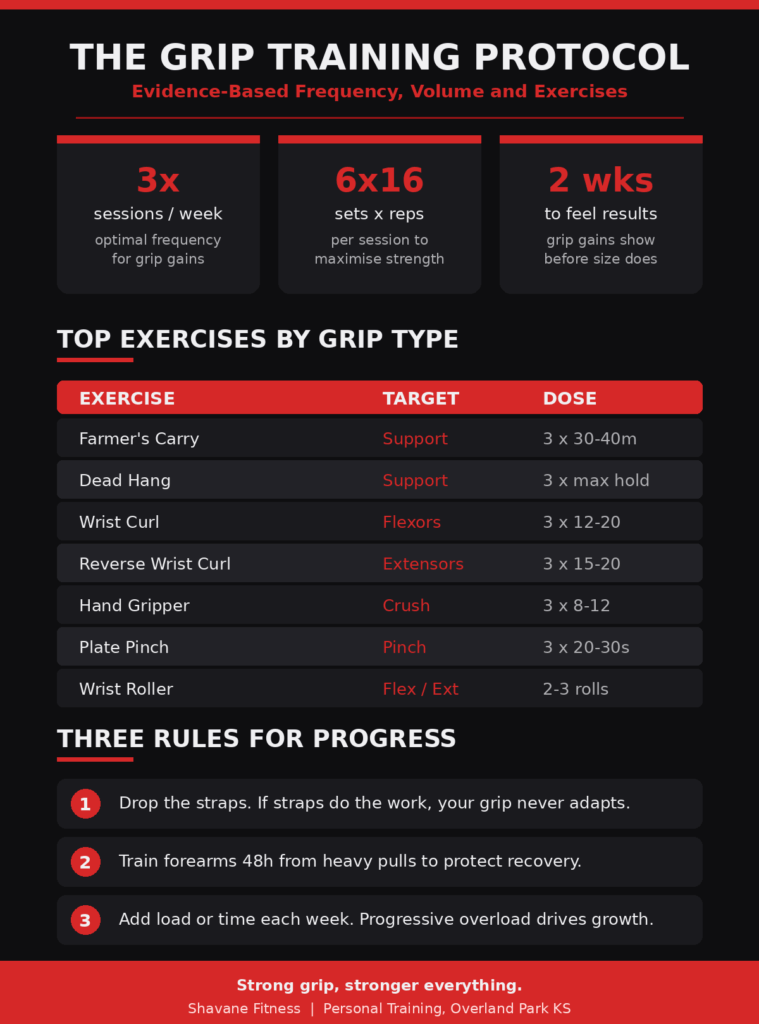
- Farmer’s carry: the single best support-grip builder. Hold heavy dumbbells or kettlebells and walk. Your grip, traps, and core all respond.
- Dead hang: hang from a bar for time. It develops support grip and shoulder health with almost no equipment.
- Wrist curl and reverse wrist curl: isolate the flexors and extensors. High reps produce a strong burn and balanced size.
- Hand gripper: trains crushing grip and finger flexors directly. Progress to thicker handles as you improve.
- Plate pinch: hold two plates together by the thumb and fingers to build pinch strength.
- Wrist roller: roll a weighted rope up and down for a brutal finisher that carries over to real-world holding strength.
A practical tip that changes results fast: thicken the bar. Wrapping a towel around a handle or using fat-grip attachments dramatically increases forearm demand. One study found that adding a thick grip lowered deadlift and row performance by 30 to 41 percent, which shows how much extra the forearms have to work.
How to Program Grip Training
The research on frequency and volume is refreshingly clear. A network meta-analysis found that training grip three times per week was the sweet spot, producing an average improvement of about 8 kilograms of force. Training two to five times weekly all helped, but three sessions balanced stimulus and recovery best. For volume, roughly six sets of sixteen repetitions per session maximised strength gains. That total does not need to be one exercise; spread it across a carry, a pinch, and a wrist curl.
| Level | Weekly frequency | Weekly working sets |
|---|---|---|
| Beginner | 2 days | 8 to 10 sets |
| Intermediate | 3 days | 10 to 15 sets |
| Advanced | 4 to 5 days | 15 or more sets |
Because forearms hold a high share of slow-twitch, fatigue-resistant fibres, they tolerate frequent work well. Still, they get hammered during every pulling session, so avoid stacking heavy grip work right next to heavy deadlift or row days. Keep at least 48 hours between the hardest grip sessions and heavy pulls, and deload every 6 to 8 weeks.
Common Mistakes That Stall Progress
The biggest error is over-relying on lifting straps. Straps have a place for heavy back work, but if they do the holding on every set, your grip never receives the stimulus it needs to adapt. Reserve straps for your heaviest pulls and let your hands work on everything else.
The second mistake is chasing pain instead of progress. Deep or sharp wrist pain means stop and swap the movement, not push through. A mild pump or light soreness is normal. Finally, many lifters train grip randomly with no progression. Like any muscle, the forearms grow through progressive overload, so add weight, reps, or hold time week over week and track it.
How Long Until You See Results
Grip strength responds quickly. Most people notice a firmer, more secure grip within about two weeks of consistent training. Visible forearm size takes longer, usually four to six weeks, partly because the forearm contains many muscles and partly because most programs undertrain them. Consistency, not heroic single sessions, drives the outcome.
Frequently Asked Questions
How often should I train grip and forearms?
Three times per week is optimal for most people, according to meta-analysis data. Beginners can start with two sessions and advanced lifters may handle four to five short sessions, provided they manage recovery around heavy pulling days.
Can I train forearms every day?
Short, light isometric holds and carries can be done daily because forearms are fatigue resistant. Heavy loaded work still needs recovery, so keep intense sessions to three or four per week and spread them out.
Do hand grippers build bigger forearms?
Grippers grow the finger flexors and add density to the palm-side forearm, but they barely load the extensors. Pair them with wrist curls, reverse wrist curls, and loaded carries for balanced size.
Should I use lifting straps?
Use them only for your heaviest back and pulling work. For grip development, train without straps so your hands are the limiting factor and are forced to adapt.
Is grip strength really linked to health?
Research associates higher grip strength with lower mortality risk, better metabolic health, and healthier blood pressure, which is why it is used clinically as a marker of overall function and healthy ageing.
What is the single best grip exercise?
The farmer’s carry, because it loads support grip heavily while training the traps, core, and posture at the same time, giving the most carryover per set.
Final Comments
Grip and forearm strength is not an accessory afterthought. It is the link that determines how much of your true strength you can actually express. Build it with a mix of carries, hangs, wrist work, and thick-bar holds, train it around three times per week with progressive overload, and respect recovery around heavy pulling. Do that consistently and your deadlift, your daily function, and your forearms will all follow.