
Gym anxiety is the spike of nervousness, self-consciousness, or dread that shows up before or during a workout in a public fitness space. Fitness professionals often call it gymtimidation, and it affects first-time visitors and five-year members alike. The feeling is real and measurable. Heart rate climbs, muscles tighten, and the brain treats an unfamiliar gym floor the same way it treats any new social setting, as a potential threat that needs to be assessed.
Survey data backs this up. Roughly half of American adults say they feel too intimidated to build a workout routine around other people, and fear of judgment is the reason cited most often. This guide covers what causes gym anxiety, what is actually happening in the body during that stress response, and the specific strategies personal trainers use to move clients from a nervous first visit to a confident weekly routine.
What Is Gym Anxiety?
Gym anxiety is a form of situational social anxiety triggered by an unfamiliar fitness environment, rather than a general anxiety disorder. It can appear as racing thoughts about being watched, uncertainty about how to use equipment, or discomfort with how the body looks or moves in front of others. Most people experience some combination of these triggers rather than just one.
| Trigger | Why It Happens | What Helps Most |
| Fear of judgment | The brain overestimates how closely others are watching | Off-peak hours, headphones, a fixed workout plan |
| Not knowing the equipment | No stored motor pattern exists for the movement yet | One session with a coach to build the pattern |
| Body image concerns | Comparing appearance instead of tracking output | Progress logs based on numbers, not mirrors |
| Fear of injury or looking foolish | Past negative experience or zero experience | Supervised practice at a light load first |
The Science Behind the Feeling
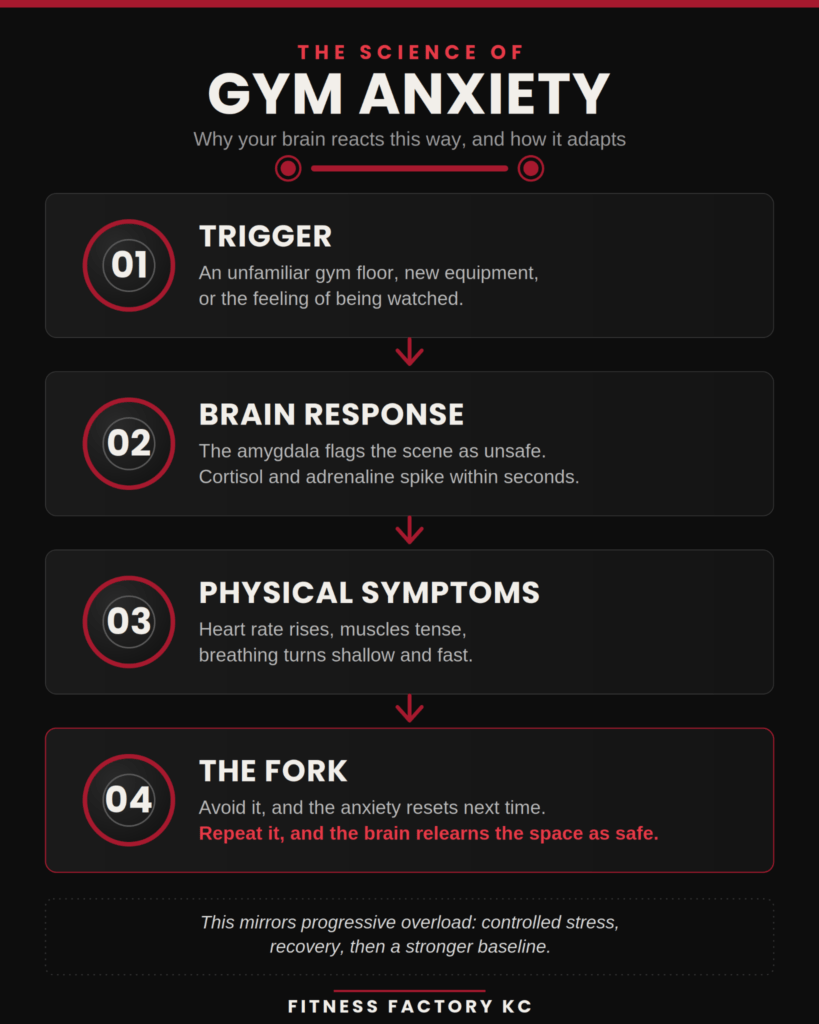
Gym anxiety is not a character flaw. It is the amygdala, the brain’s threat detector, flagging a new environment as unsafe before the rational cortex has a chance to weigh in. That triggers the sympathetic nervous system and a short burst of cortisol and adrenaline, the same fight-or-flight response used for any perceived social or physical threat.
That stress response is also trainable, not fixed. Exercise itself is what physiologists call a hormetic stressor: a controlled, repeatable stress that the body adapts to and gets progressively better at managing. The same repeated exposure that builds muscle through progressive overload also recalibrates the nervous system’s baseline stress response. Research on exercise-related anxiety consistently finds that regular training lowers resting cortisol and improves emotional regulation over time, even though a single hard session temporarily raises it. Discomfort now is often the mechanism behind confidence later, not a sign to stop.
How Common Is Gym Anxiety?
Gym anxiety is one of the most common barriers to regular exercise, not a rare or unusual reaction. National polling conducted by research firm OnePoll, surveying roughly 2,000 U.S. adults, found that about half feel too intimidated to build a workout routine around other people, and nearly one in three describe the idea of getting into shape as anxiety-inducing on its own. The pattern holds across age groups, genders, and experience levels, which is why most reputable gyms build onboarding, tours, and beginner coaching directly into their membership process.
6 Science-Backed Ways to Overcome Gym Anxiety
1. Use Progressive Exposure, Not All-or-Nothing Effort
Confidence follows the same progressive overload principle used to build strength. Start with 10 to 15 minutes at an off-peak hour, then add time or intensity in small increments once the previous level feels routine. Jumping straight into a 90-minute session in a crowded gym gives the nervous system too much new input at once.
2. Learn Proper Form From a Coach First
Unfamiliar movements feel awkward because the brain has not yet built an automatic motor pattern for them. Motor learning research shows this improves in stages, moving from a clumsy, highly conscious first attempt to a smooth, automatic one with repeated correct practice. A few sessions with a certified trainer compress that timeline and lower injury risk at the same time.
3. Use Box Breathing to Settle the Nervous System
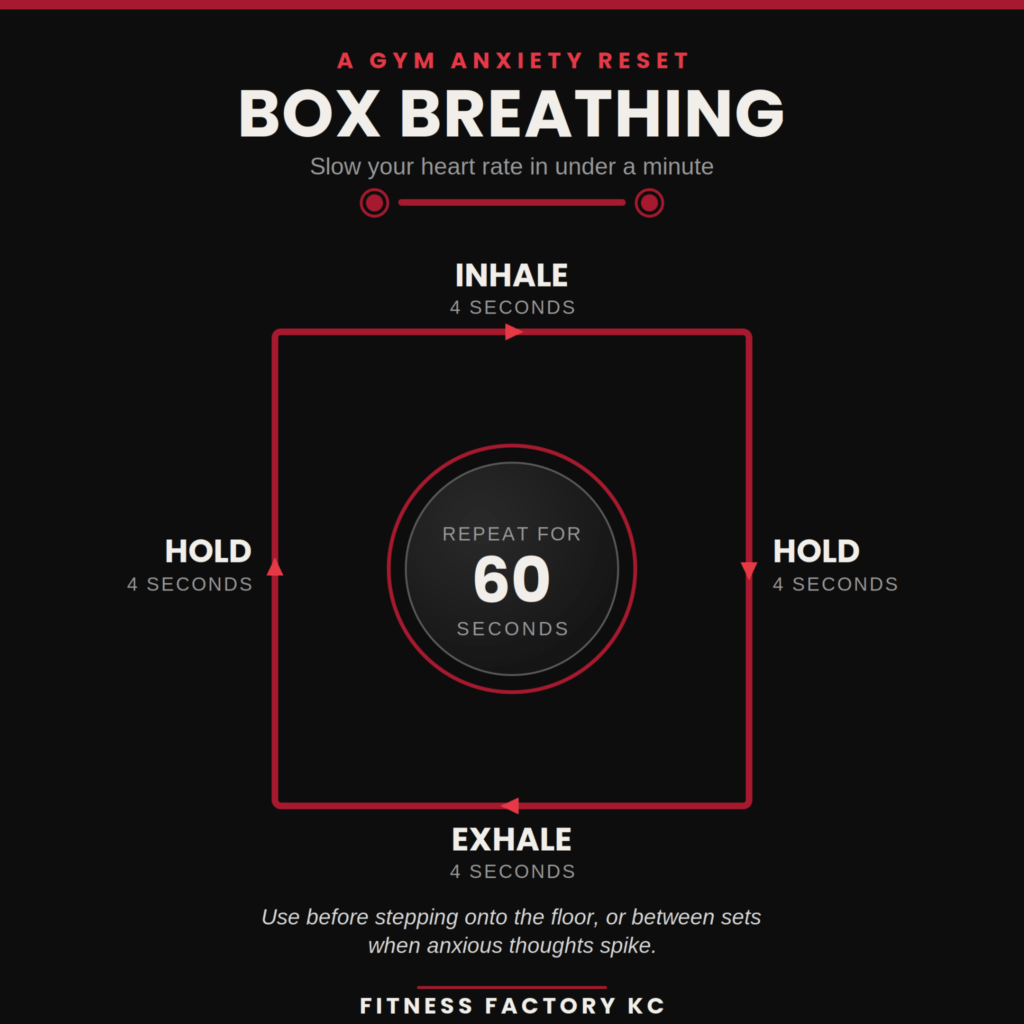
Box breathing directly counters the fight-or-flight response driving gym anxiety. Inhale for four seconds, hold for four, exhale for four, hold for four, and repeat for one minute before or during a workout. Lengthening the exhale relative to the inhale activates the parasympathetic nervous system and lowers heart rate within minutes.
4. Set Process Goals Instead of Outcome Goals
Research on exercise adherence consistently finds that people who focus on process goals, such as completing three sessions this week, stick with training longer and report less anxiety than people focused only on outcome goals like a target weight. Track the behavior you controlled, not just the result.
5. Familiarize Yourself With the Space Before You Train
A short tour, a walk-through during off-peak hours, or a look at equipment photos ahead of time removes the single biggest driver of gym anxiety, the unknown. Knowing where the water fountain, locker room, and specific machines are removes several small decision points that otherwise add up to stress.
6. Train With a Buddy or in a Small Group
Working out alongside one other person lowers perceived social threat because attention is shared and accountability replaces self-consciousness. Small-group personal training, typically two to eight people, provides the structure of coaching with the support of a group, without the exposure of a packed gym floor.
Frequently Asked Questions
Is gym anxiety a real medical condition?
Gym anxiety itself is not a formal diagnosis, but it is a well-documented form of situational social anxiety with a measurable physical stress response. If anxiety symptoms show up across many areas of life, not just the gym, it is worth discussing with a doctor.
What is gymtimidation?
Gymtimidation is a common term for gym anxiety, describing the nervousness, self-consciousness, or fear that keeps people from starting or continuing a gym routine.
How long does it take to get over gym anxiety?
Most people notice a meaningful drop in anxiety within about four to six consistent visits, since that is roughly how long it takes the brain to build familiarity with a new routine and environment.
Can a personal trainer actually help with gym anxiety?
Yes. A trainer directly addresses the two biggest triggers behind gym anxiety, unfamiliarity with form and feeling unsupervised in a new space, while building a program suited to your current fitness level.
Getting Started in Overland Park
Gym anxiety fades fastest with the right first experience, not with willpower alone. At Fitness Factory KC in Overland Park, founder Shavane Morrison built the gym around that first experience: a smaller, locally owned space rather than a crowded big-box floor, with certified coaching (NASM, NCSF, and a biomechanics-focused training background) built into every membership. Members across the Kansas City metro start with a guided session, a plan suited to their current level, and a coach who corrects their form in real time, rather than a self-guided walk on an unfamiliar floor. Contact Fitness Factory KC today to schedule a first session and start training with a coach instead of alone.